
How Imaging Centers Are Using AI to Book Appointments Days Sooner
When a doctor orders an MRI in a market with several imaging centers, the office may fax the same order to four of them at once, according to Tim Haley, chief technology officer of Capitol Imaging Services. Whichever center books the patient first usually gets the scan.
“It’s a race to see who can get the patient scheduled and completed first.”
— Tim Haley, Chief Technology Officer, Capitol Imaging Services
That race is decided before the patient ever gets a date. Someone has to read the fax, find the patient in the system, enter the order and then call to schedule. Done by hand, that can take days. AI to automate scheduling can trim many days to just a few. And the goal is clear, to get patients in to be seen sooner.
With AbbaDox’s Ora AI at these centers, orders get entered in minutes and patients get booked days sooner. Dashboard data from three imaging centers that use AbbaDox shows just how much sooner: Derry Imaging, with seven locations in New Hampshire; SouthCoast Health, a health group with two imaging locations in Georgia; and Regional Medical Imaging (RMI), an independent network with 10 locations in Michigan. At each one, orders handled by staff were compared with orders AI handled from start to finish, over the same month, Sept. 25 to Oct. 25, 2026. The results also show what drives them further: how much of the work each team is ready to hand over to AI.
Appointment turnaround time: Faster from fax to booked
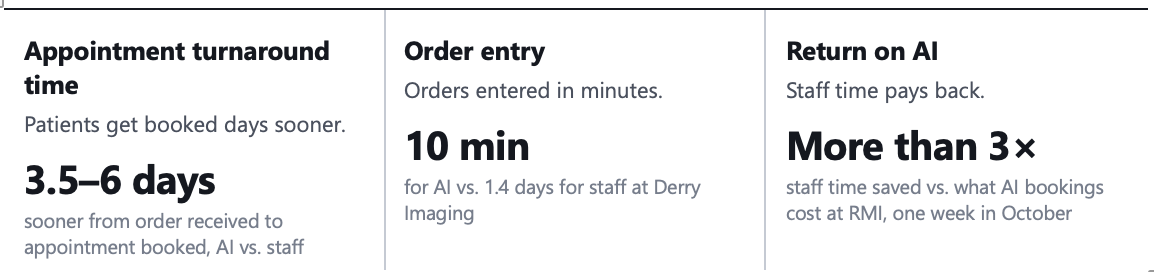
At these three centers, getting a patient booked takes about 5 to 9 days when staff handle the order. When AI handles it, it takes about 1 to 3 days.
The first step, entering the order, goes from hours or days to minutes. At Derry Imaging, AI enters an order in about 10 minutes, compared with 1.4 days on average for staff. Before AI, the team there sorted through 300 to 400 faxes a day to find each patient’s order.
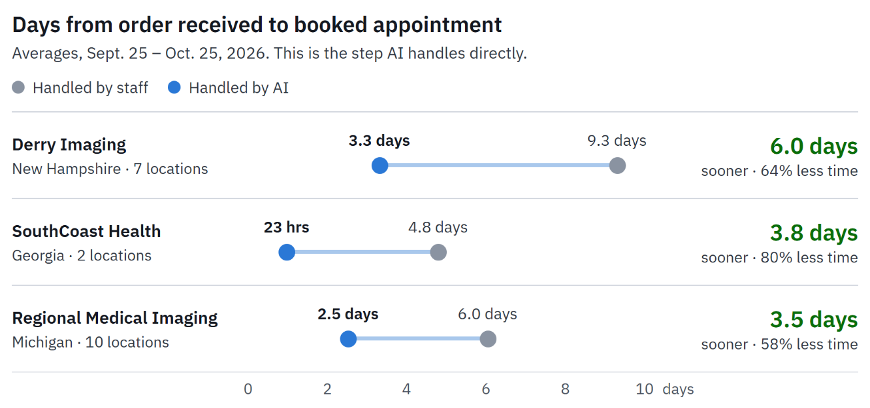
The head start carries through to the final report. Measured all the way to a signed report, AI-handled orders finished 3 to nearly 10 days sooner than staff-handled orders at the same center. Most of that time is won at booking, the step AI handles directly: 3.5 to 6 days faster at all of the centers.
Patients hear back sooner
Patients with a new imaging order want to know when they’ll be seen and when they’ll get answers. The center that calls first with a date often gets the booking.
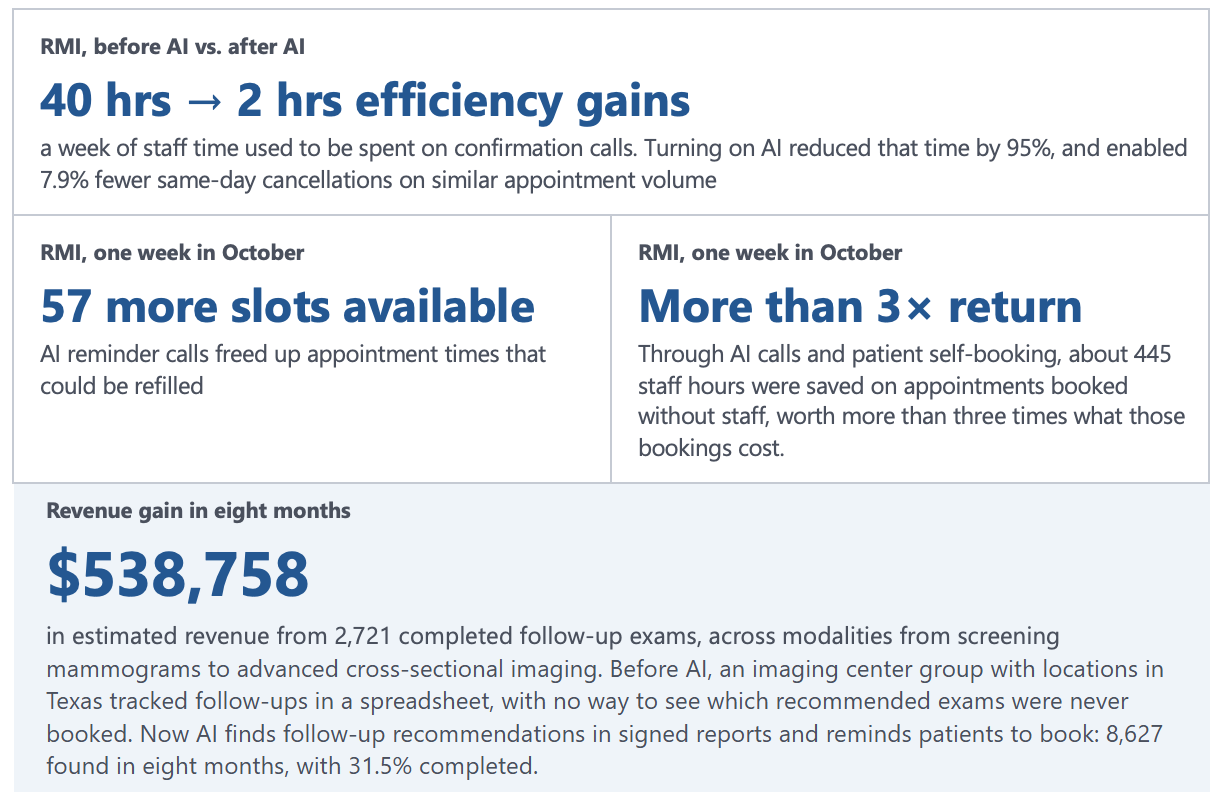
At RMI, orders AI handled from start to finish went from order received to appointment booked in 2.5 days, compared with 6 days when staff handled them. AI calls each patient as soon as the order comes in, explains how to prepare for that exam and confirms the visit. Reschedules, safety questions and when a caller requests to speak with a person go to staff with all the needed details, around the clock. In the months after RMI went live, the share of patients who confirm their appointments rose from 41.5% to 45.6%, compared with a similar stretch before.
At Capitol Imaging Services, AI reads each faxed order and matches it to the right patient 99.59% of the time. Orders it can’t match go to staff on a worklist, with the reason.
Filling more slots with the same team means more revenue
Imaging centers can’t just raise prices since payer contracts set most of them. Growth comes from filling more slots and spending less to fill them. Faster scheduling helps with both.
AI buy-in is what takes it further
At all three centers, orders AI handled moved days faster on average. The bigger opportunity is volume: the more of the work a center hands to AI, the more of its orders get booked days sooner. SouthCoast started small: it went live in May 2026 with AI booking only screening mammograms and bone-density scans, then added ultrasound, CT and MRI.
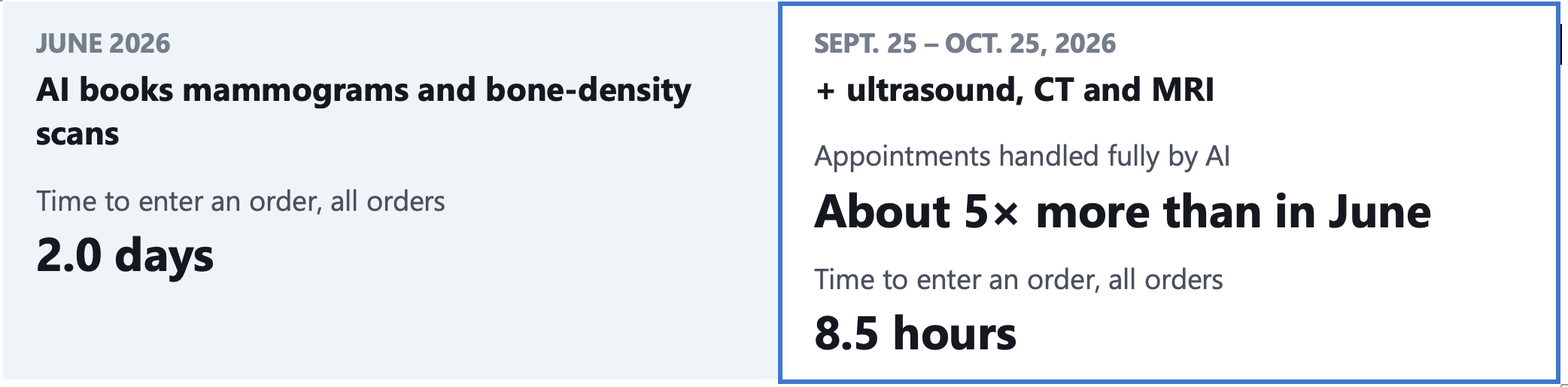
Both entry times cover all orders, staff- and AI-handled.
Yaniv Dagan, CEO of AbbaDox, says the harder part is usually not the software but the rules around it, which often live in the heads of a few long-time employees.
“Most of the small rules of engagement, business rules, they’re in some individuals’ head. We call it tribal knowledge.”
Leaders want the change, but the managers who would carry it out are buried in daily work and tight turnaround times. Closing that gap “requires a partnership between the C-level and the mid-level operation teams,” Dagan says. “When we offer those AI solutions, it comes with a service.” AbbaDox’s dedicated AI team works with practice leaders to turn those rules into automated workflows.
In Dagan’s experience, centers that name an owner and retire outdated workflows give AI more of the work, and buy-in from the front desk matters as much as from the top. Every order AI handles is one staff no longer have to enter or chase by phone, so hours saved and slots freed grow with the share; RMI’s 445 hours came from appointments booked without staff. For the person checking AI-extracted fax data, Dagan says, the day goes from “70 inputs or 70 referrals” to “200, 300.”
What It Adds Up To
For these centers, the clearest payoff from AI is speed, revenue and allowing staff to handle higher-end decision-making and attend more directly to patients. Automating intake and scheduling gets patients booked days sooner, and everyone down the line feels it. Here is the full picture, from the day the order arrives to the day the radiologist signs the report.
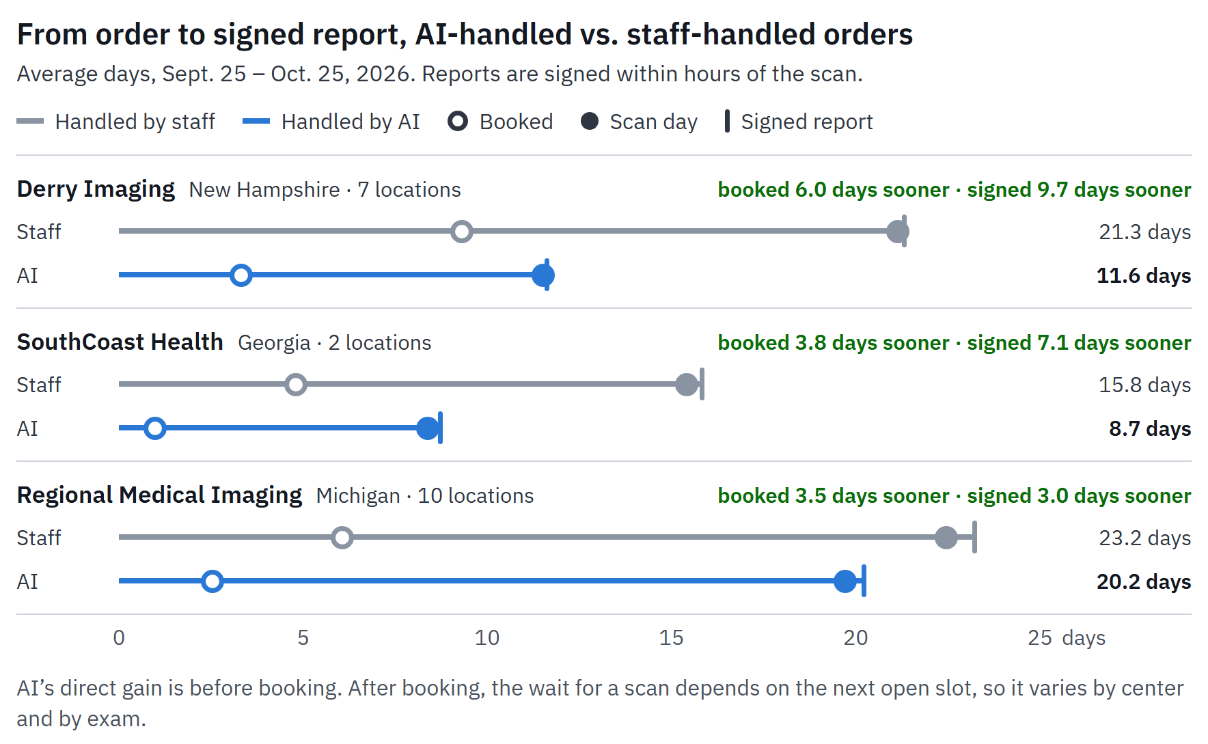
The numbers behind this story
Averages from AbbaDox Turnaround Time dashboards, Sept. 25 – Oct. 25, 2026.
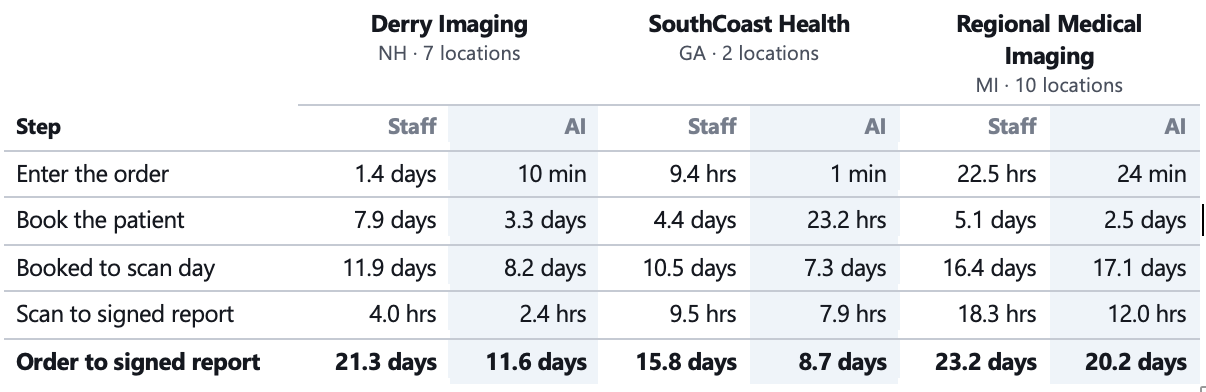
At Derry and SouthCoast, patients booked by AI were also scanned three to four days sooner after booking; at RMI, the wait after booking was about the same (17.1 vs. 16.4 days).
Where to Start
- Time each step. Track time to enter, time to book and time to a signed report separately. AbbaDox users see each step in their Turnaround Time dashboard, split by staff-handled and AI-handled orders.
- Give AI more of the work over time. Start with simple exams, as SouthCoast did with screening mammograms, and add more as the team sees the results.
- Give the project an owner. Pair the leader who wants the change with the managers who run the schedule, and get the payer and modality rules out of people’s heads before handing them to AI.
- Tie it to the business. Days to book, same-day cancellations, follow-up exams completed and staff hours on the phone show whether the speed is paying off.

Camila Ordonez is a Product Marketing Manager at AbbaDox. Connect with her here: [email protected].
Want to talk to any of these centers? We’ll connect you.
Get in touch: abbadox.com/get-a-demo
- See how Ora works: abbadox.com/ai
- New at RSNA 2026: chat with Ora, an AI assistant that answers questions from a center’s own data.
- Meet AbbaDox at RSNA 2026, booth 6327, North Hall, or at the AI Theater on Monday, Nov. 30, at 11:30 a.m. CT: abbadox.com/rsna
- Watch our recent webinar: The Front Office Is Where the ROI Is