
At Hackensack Radiology, Internal Friction Evaporated with the Arrival of a Radiology Cockpit and Operations Platform

When soaring imaging volumes began to exacerbate workload inequity and drive physician burnout, the leadership team at one prominent radiology practice found the root cause easy to isolate: operational fragmentation.
The diagnosis was not difficult. The practice was managing a fragmented matrix of three distinct PACS, three separate EMRs and three different reporting platforms.
As any whole is greater than the sum of its parts, the team decided, this challenge called not for piecemeal fixes but a comprehensive structural overhaul.
The practice feeling the strain was Hackensack Radiology Group in New Jersey. The turning point arrived on the heels of the COVID crisis, when a dramatic post-pandemic surge in imaging volumes collided with a tightening labor market. This one-two punch has pushed Hackensack Radiology’s legacy software past its breaking point.
System bottlenecks were severe. Specialists could not access work stranded in separate silos. The fastest readers silently absorbed the overflow, widening the equity gap, and a binary STAT/non-STAT scheme failed to capture the nuanced gradations of urgency required to optimize throughput.
“We recognized that optimizing the workflow was no longer enough; we needed to actively protect and orchestrate our workforce,” President Mohit Naik, MD, recalls for Radiology Business. “The internal friction had gotten to be too much.”
He came to appreciate the depth of the practice’s technological need, which had grown from a “simple solution for isolated exam-routing” to “an enterprise framework capable of dynamically balancing our entire clinical capacity.”
“We finally have the advanced infrastructure we need to deliver our best work for patients and referrers.”
—Mohit Naik, MD, President, Hackensack Radiology Group

But how to make it happen? Naik wasn’t sure until his team’s search for a fittingly experienced industry partner brought them to Fujifilm and RealTime Medical’s Synapse Worklist Orchestrator (SWO).
“We evaluated nearly every product claiming to have perfected workflow orchestration,” Naik says. “SWO was, for us, the only solution capable of adapting to our complex enterprise workflows and truly solving our challenges around workload balancing.”
Going on two years into Hackensack’s use of the solution, Naik is ready to tell his operational transformation story to other radiology decision-makers who may face similar forks in the road.
To simplify the complex, start here
Hackensack Radiology is a dominant force in the northern half of the Garden State. Comprised of 50 radiologists, the practice operates four imaging centers and provides professional services for three hospitals.
The cornerstone of this hospital network is Hackensack Meridian Health’s Hackensack University Medical Center, a flagship quaternary care hospital and level-one trauma center. This premier institution houses a comprehensive cancer center, stroke center, children’s hospital, transplant center and, with more than 150,000 visits in 2025, one of the 10 busiest emergency departments in the country.
“A high-level view of our workload across our enterprise quickly reveals the true complexity of our clinical operations,” Naik says.
When the need for an operational transformation and workflow orchestration solution became acute, around 2022, Naik and co-leaders identified three outcomes any commercial solution would have to promise—and deliver.
- Measurable gains in efficiency: Drive clear quantifiable advancements in overall clinical productivity.
- Accelerated throughput: Shorten turnaround times for urgent and otherwise time-sensitive cases.
- Operational balance: Equitably distribute work among subspecialists and generalists alike.
With its implications for patient care, clinical quality and radiologist morale—and by extension recruitment and retention—addressing equity was “our single highest priority,” Naik says.
Among other things, he adds, this meant the selected solution would need to automatically prioritize reads by criticality, send every study to the most relevantly subspecialized radiologist available, nix the ability of any radiologist to cherry-pick the most desirable reads and, in sum, “bring Hackensack fully into 21st-century radiology.”
Results that need almost no explanation
Looking back on the search for just the right solution, Naik says most of the products his team reviewed were overly “IT-based.” Many could do a lot of things well, he explains, but “they weren’t capable of driving true operational transformation.”
When their turn came to pitch Hackensack Radiology, the SWO team impressed the selection committee with their highly stable and flexible platform backed by a proven industry track record.
Beyond comprehensive workflow management, Naik and colleagues were impressed by the platform’s capacity for multifaceted peer learning and advanced bidirectional communication.
The empirical results spoke for themselves, Naik notes before sharing metrics of the success Hackensack Radiology has achieved since implementing the FujiFilm RealTime Medical platform:
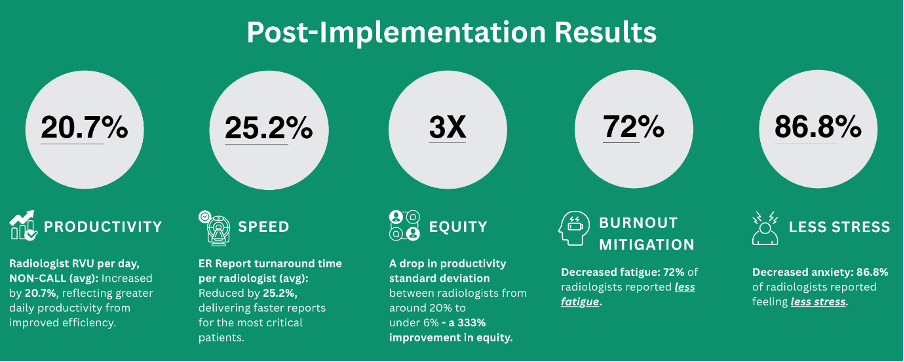
The middle metric, representing more than a threefold improvement in equity, was particularly rewarding for Naik. “Operational inequity is a contagion that, left unchecked, can erode the culture of a group,” he emphasizes. “A sharp drop in productivity standard deviation among radiologists—from around 20% to under 6%—is a significant achievement.”
Further, surveying the 50 radiologists on aspects of job satisfaction, Naik and co-leaders of the practice found 85% reported working with less stress and anxiety, more than 70% feeling less fatigued, and over 80% reporting an increased sense of fairness.
The long view comes into focus
Ultimately, one of the most significant long-term deliverables at Hackensack Radiology, Naik volunteers, has been the evolution of the solution “from an operational initiative to a durable strategic asset.”
“By utilizing a radiology operations platform capable of absorbing imaging exams from diverse sources, we can actively collaborate with external practices more seamlessly,” he says. “This capability has fundamentally shifted our growth model, allowing us to scale our operations with unprecedented agility.”
Expounding further on the strategic angle, Naik says Hackensack Radiology’s approach to talent acquisition has become smarter. Instead of being forced to hire for a hyper-specific subspecialty at any given moment, the practice can now confidently onboard “any qualified radiologist, regardless of their subspecialty focus. This unlocks an entirely new level of recruitment flexibility.”
“When a new physician joins our practice, their unique skill set is instantly integrated into our workflows,” Naik says. “They can focus heavily on their preferred case mix, and the system dynamically and equitably distributes volume across our broader team.”
The resulting “operational fluidity” directly translates into stronger recruitment, higher retention and increased resilience, he adds.
For Naik, the overall modernization at Hackensack Radiology has brought a “new sense of gratitude” for the radiology profession and his role within it.
“It’s an exciting time to practice radiology,” he says. “We are fortunate to operate at the present intersection of technology and medicine. We finally have the advanced infrastructure we need to deliver our best work for patients and referrers.”
To learn more about Fujifilm’s Synapse Worklist Orchestrator (SWO) in partnership with RealTime Medical, click here.

Dave P. has worked in journalism, marketing and public relations for more than 30 years, frequently concentrating on hospitals, healthcare technology and Catholic communications. He has also specialized in fundraising communications, ghostwriting for CEOs of local, national and global charities, nonprofits and foundations.