We set out to find radiology and imaging up-and-comers under 40 who stand out, landing on a laudable list of radiologists, interventionalists, business leaders, researchers, entrepreneurs, educators, AI developers, technologists and mentors.
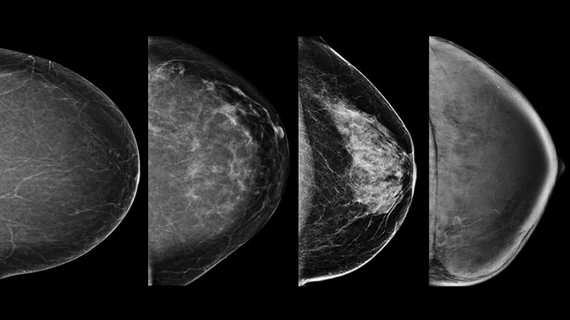
Example of the four types of breast tissue density. The density of fibroglandular tissue inside the breast impacts the ability to easily see cancers. On X-ray mammography, cancer and dense breast tissue both appear as white and can hide smaller cancers on 2D mammography. Dense breasts are also a risk factor for cancer. Cancers are very easy to spot in fatty breasts, but are almost impossible to find in extremely dense breasts. These examples show craniocaudal mammogram findings characterized as almost entirely fatty (far left), scattered areas of fibroglandular density (second from left), heterogeneously dense (second from right), and extremely dense (far right). Read more. Image courtesy of RSNA
Breast density is most often discussed within the context of cancer risk, but new research suggests that it also could be used as a marker of cardiometabolic health.
Contrast-enhanced thoracoabdominal CT image in a 55-year-old male patient who underwent hepatocellular carcinoma staging shows unilateral patchy subpleural ground-glass opacities (arrows) without CT fibrotic features, lower than 5% in any lung zone. These CT features were classified as indeterminate for interstitial lung abnormalities.
Caption and photo courtesy of Radiology.
This is despite experts cautioning that these findings should be "systematically and fully assessed" due to their progressive nature.
A new analysis in JACR estimates that spotting the signs of a previously undetected stroke could benefit up to 200,000 people in the United States every year.