
Combining structured reporting with AI drastically reduces turnaround times
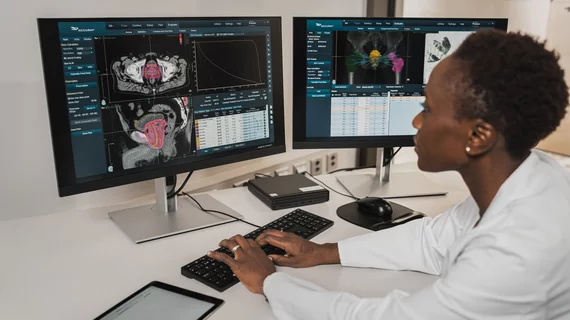
Alongside structured templates, artificial intelligence has the potential to significantly improve radiologists’ report turnaround times.
Both structured reporting and AI support have been touted as promising solutions for streamlining radiology workflows while also making results more consistent. According to a new analysis, combining the two tools could further enhance readers’ performance by increasing their diagnostic accuracy. Findings from the study suggest the combo could significantly reduce report turnaround times as well.
Details from the analysis were published this week in RSNA’s flagship journal, Radiology.
“With the growing demand for radiologic services and increasing imaging volumes and complexity, it is critical to develop reporting workflows that balance efficiency and accuracy while minimizing distractions and reducing nonimage interactions,” Robert M. Siepmann, MD, with the department of diagnostic and interventional radiology at University Hospital Aachen in Switzerland, and colleagues noted. “However, little is known about how different reporting modes—and AI assistance—impact diagnostic workflows.”
The group sought to quantify how different reporting modes affect readers’ focus, accuracy and efficiency. Four novice and four non-novice readers participated in the prospective study, each assessing 35 bedside chest X-rays using three different reporting modes: free-text reporting, structured reporting with itemized and graded findings, and AI-prefilled structured reporting. The images were displayed on a customized viewer equipped with an eye-tracking system, enabling researchers to evaluate how often readers changed their gaze while assessing and reporting on the radiograph.
Both free-text and structured reporting yielded similar diagnostic accuracy, but this improved when using the AI combo; both sets of readers showed improvements when using this combination in comparison to free-text reporting. AI structured reporting helped readers achieve significantly shorter mean reporting times, decreasing from 88 seconds for free-text reporting to 37 seconds for structured reporting and 25 seconds for the AI combo.
Quick eye movements between radiographs were lower with artificial intelligence, as was mean total fixation duration for reports. All eight readers expressed preference for the combination of AI and structure, each indicating they would be willing to adopt the method clinically, with seven citing its increased efficiency.
“Structured reporting enhanced efficiency by directing visual attention toward the image, particularly benefiting inexperienced readers. Artificial intelligence–prefilled [structured reporting] improved diagnostic accuracy. Beyond algorithmic accuracy, factors such as AI output timing (concurrent vs. second-reader workflows), framing (experimental vs. approved), and user interface design may critically influence how radiologists respond to AI suggestions,” the team noted, suggesting that this should be the focus of future studies on the topic to “optimize human-AI collaboration.”
Read more here.

In addition to her background in journalism, Hannah also has patient-facing experience in clinical settings, having spent more than 12 years working as a registered rad tech. She began covering the medical imaging industry for Innovate Healthcare in 2021.