
Commercially available AI spots up to 1/3 of interval cancers missed by radiologists
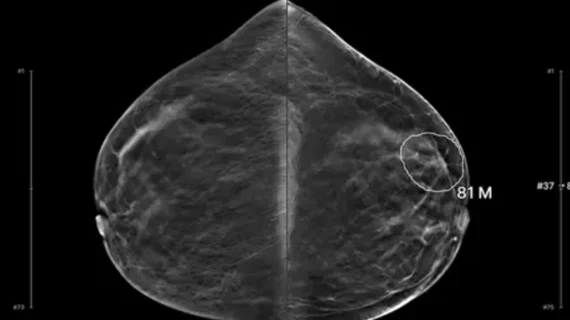
New data highlight the potential for an artificial intelligence tool to improve the detection of interval cancers on digital breast tomosynthesis (DBT) exams.
According to a new study in RSNA’s flagship journal Radiology, AI can increase interval cancer detection by up to one-third. Considering the often-aggressive nature of interval breast cancer, the findings could represent a significant step toward improving patient outcomes, authors of the paper suggest.
“A symptomatic [false-negative] cancer, also known as an interval cancer, presents with symptoms after a negative screening mammogram. Compared with screening-detected (true-positive) cancers, interval cancers typically have poorer outcomes due to more aggressive biology and rapid growth,” Manisha Bahl, MD, MPH, the breast imaging division quality director and co-service chief at Massachusetts General Hospital, and colleagues explained. “Given the lack of long-term outcome data in women screened with digital breast tomosynthesis, the interval cancer rate is often used as a surrogate marker for long-term outcomes, with the assumption that lowering this rate could reduce breast cancer–related morbidity and mortality.”
The group retrospectively analyzed screening DBT exams acquired immediately before confirmed interval cancer diagnoses between February 2011 and June 2023, applying an AI algorithm (Lunit INSIGHT DBT v1.1) to each of the studies. The algorithm flagged and scored lesions from 0 to 100, with scores above 10 indicating positivity. Two breast radiologists examined the algorithm’s annotations to determine whether they corresponded with the site where the cancer was eventually diagnosed.
There were 224 interval cancers included in the analysis, 32.6% of which were correctly identified by AI and initially missed by radiologists. Lesions missed by radiologists but spotted by AI tended to be larger in size at surgical excision and involve axillary lymph nodes. Using the threshold score of 10 or higher, AI correctly localized 84.4% of the lesions and accurately categorized 85.9% of true-positive cancers from the entire cohort.
“Our study shows that an AI algorithm can retrospectively detect and correctly localize nearly one-third of interval breast cancers on screening DBT exams, suggesting its potential to reduce the interval cancer rate and improve screening outcomes,” the authors note. “These findings support integrating AI into DBT screening workflows to enhance cancer detection, but its real-world impact will ultimately depend on radiologist adoption and validation across diverse clinical environments.”
Learn more about the findings here.

In addition to her background in journalism, Hannah also has patient-facing experience in clinical settings, having spent more than 12 years working as a registered rad tech. She began covering the medical imaging industry for Innovate Healthcare in 2021.