
‘Hybrid’ AI reading strategy cuts radiologists’ mammography workload by nearly 40%
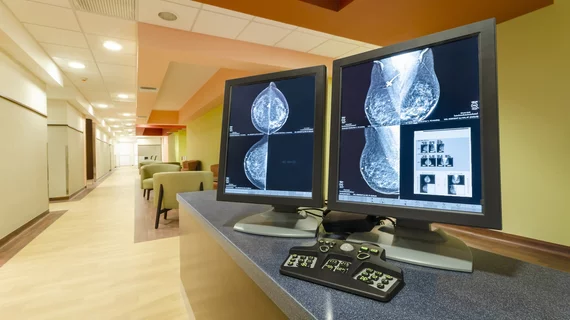
A “hybrid” artificial intelligence strategy—using a combination of radiologist readers and standalone AI interpretation of cases—can cut rads’ workloads by nearly 40%, according to new research.
Such technology has shown great promise in boosting physician performance, including helping to triage scans requiring added attention. However, AI implementation in breast cancer screening remains limited for various reasons, amid concerns it may miss some relevant cases, experts wrote Tuesday in RSNA’s Radiology.
To maximize mammography AI’s potential, Dutch imaging researchers are trying a new approach. They’ve trained their technology to produce two outputs—the probability of malignancy for a cancer case, along with AI’s certainty of its own assessment. This allows artificial intelligence to focus on exams in which it is confident while filtering others with uncertainty to physicians.
Researchers utilized this approach on a set of old mammograms, with recall decisions made by the AI model only when predictions were deemed confident. Otherwise, two radiologists read the exams instead. Using this strategy reduced rads’ workload by about 38% without changing recall nor cancer detection rates.
“The use of AI with uncertainty quantification can be a possible solution for workforce shortages and could help build trust in the implementation of AI, both in the clinic and beyond,” Sarah D. Verboom, MSc, a doctoral candidate in the Department of Medical Imaging at Radboud University Medical Center, Netherlands, and co-authors wrote Aug. 19.
The study’s dataset included over 41,000 exams from almost 16,000 women at a median age of 59. Mammograms were gathered between 2003–2018 through the Dutch National Breast Cancer Screening Program and included 332 cases detected as part of regular screening and 34 more during intervals in between.
Using the best-performing uncertainty metric, about 62% of exams were read by radiologists, the authors found. Hybrid reading resulted in a recall rate—the percentage of screening exams where a rad interprets findings as abnormal, requiring further evaluation—of about 23.6% and cancer detection of 6.6%. That’s compared to the standard approach where two rads read the breast images, which notched rates of 23.9% and 6.6%, respectively.
If the study results had occurred in regular clinical practice, Verboom noted, AI would have made the decision to recall 19% of women for follow-up. Further research is needed first, however, before using this approach in real world settings to determine how it might decrease physicians’ reading time.
"I think in the future, we could get to a point where a portion of women are sent home without ever having a radiologist look at their mammogram because AI will determine that their exam is normal," she said in a statement from the Radiological Society of North America, which published the study. "We're not there yet, but I think we could get there with this uncertainty metric and quality control."
She hopes future commercial AI breast imaging products work to integrate this metric into their technology, given its usefulness.
"The key component of our study isn't necessarily that this is the best way to split the workload, but that it's helpful to have uncertainty quantification built into AI models," Verboom said.
You can find the full study here and a corresponding editorial by Vienna-based radiologist Dr. Pascal Baltzer here.

Marty Stempniak has covered healthcare since 2012, with his byline appearing in the American Hospital Association's member magazine, Modern Healthcare and McKnight's. Prior to that, he wrote about village government and local business for his hometown newspaper in Oak Park, Illinois. He won a Peter Lisagor and Gold EXCEL awards in 2017 for his coverage of the opioid epidemic.