
Congressmen introduce bill to delay controversial physician pay ‘efficiency’ adjustment
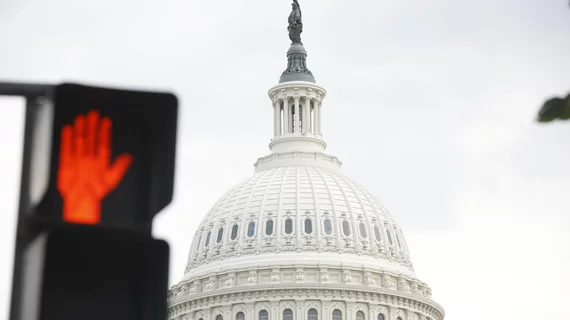
Bipartisan members of Congress have introduced a bill to delay the controversial “efficiency” adjustment to physician pay.
Proposed under the Medicare fee schedule last year, the change would implement an across-the-board 2.5% cut for most non-time-based doc services. CMS has contended only a small number of billing codes are considered for revaluation annually. Often, these updates are influenced by physician surveys with “low response rates” from participants “who may have inherent conflicts of interest.”
Medicare believes the introduction of new technologies such as AI will only make radiologists and other physicians more efficient, calling for pay cuts to counter this. However, Reps. Ron Estes, R-Kan., and Tom Suozzi, D-N.Y., on Feb. 12 introduced legislation that would delay the adjustment, responding to concerns from dozens of medical societies.
“Doctors are overwhelmed as it is,” Suozzi said in a statement. “They’re suffering from record rates of burnout while spending more time filling out paperwork than with their patients. Asking them to work even faster without properly understanding what actually affects procedure times doesn’t make sense. This bipartisan bill delays an unvetted and potentially harmful policy from taking effect too haphazardly.”
The bill has drawn support from nearly 40 medical societies, who recently wrote to the two representatives, thanking them for the proposal. Those signing the message included the American Society for Radiation Oncology, American Society of Nuclear Cardiology and the Society for Cardiovascular Magnetic Resonance. The Radiology Business Management Association also voiced its support for the bill on Tuesday, with addressing the efficiency adjustment one of its top lobbying priorities in 2026.
The efficiency adjustment is based on “incomplete and outdated data” and fails to reflect the reality of the modern radiology practice, notes Linda Wilgus, co-executive director of the RBMA. Today’s imaging environment is marked by “increases in image volume, growing after‑hours demand, and the adoption of technologies…that often add cost and workload rather than reduce it,” she added.
“Applying an arbitrary across‑the‑board reduction to non‑time‑based work RVUs undervalues physician work, compounds decades of declining reimbursement, and threatens patient access at a time when the nation is already facing a severe shortage of radiologists,” she told Radiology Business by email Feb. 17. “RBMA strongly supports legislation that ensures any future adjustments are grounded in accurate data, transparent analysis and a full understanding of how changes in medical practice truly affect patient care.”
More on the legislation
CMS plans to revisit the efficiency adjustment every three years, with assumptions that services will continue to be delivered faster in the future. Yet, previous studies have shown that 90% of procedures had the same or longer operative times in 2023 than they did in 2019, the two congressmen noted.
Also troubling: The 2.5% cut is a flat rate based on general economy-wide labor productivity, rather than actual clinical work or patient complexity. With many docs’ contracts using work RVUs to calculate pay, “these cuts will decrease compensation and threaten patient access," Estes and Suozzi said.
Reimbursement reductions also occur during a time when practice operational costs have increased 59% since 2001, with a 33% decline in physician-adjusted pay, they added, citing a commonly used statistic from the American Medical Association. Rep. Estes noted that he has heard concerns from physicians, both in Kansas and nationally, about the pay change.
House Resolution 7520 proposes delaying the efficiency adjustment until at least 2030 while also requiring the Health and Human Services secretary to produce a report to Congress within two years, explaining why the adjustment is necessary. It also would include further specificity on physician services that have not been revalued or reviewed within the last 10 years. HHS can potentially implement the adjustment starting in 2030, provided it first consults with impacted physician societies, among additional stipulations.
Others supporting the bill include the American College of Surgeons, the American Academy of Orthopedic Surgeons, American Society of Echocardiography and numerous more. The American Society of Nuclear Cardiology also highlighted the bill in a news update published Monday, encouraging physicians to ask their representatives to support the bill.
“The 2.5% reduction to work RVUs…must be delayed until CMS is able to produce empirical evidence that an across-the-board reduction is appropriate. That’s our message to Congress,” ASNC President Jamieson M. Bourque, MD, MHS, said in a statement Feb. 16.

Marty Stempniak has covered healthcare since 2012, with his byline appearing in the American Hospital Association's member magazine, Modern Healthcare and McKnight's. Prior to that, he wrote about village government and local business for his hometown newspaper in Oak Park, Illinois. He won a Peter Lisagor and Gold EXCEL awards in 2017 for his coverage of the opioid epidemic.