
FDA clears new PET/MRI combo system from Siemens Healthineers
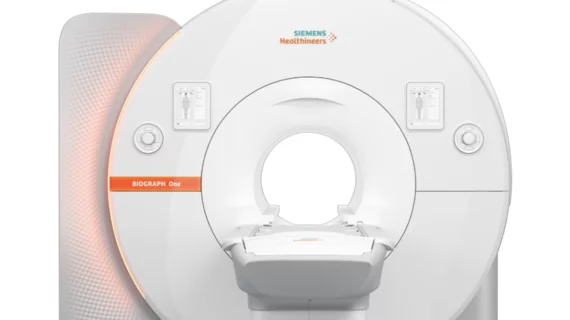
The latest version of Siemens Healthineers’ positron emission tomography/magnetic resonance imaging scanner has just been cleared by the U.S. Food and Drug Administration.
The Biograph One is the company's second-generation PET/MRI combo scanner—its first in 14 years. It allows for simultaneous visualization of organ location, function and cellular metabolism. Siemens says the scanner’s capabilities position it to be a valuable tool amid the growing field of theranostics and personalized cancer treatment.
“Over the past few years, we have seen a fundamental shift in personalized medicine. This shift has been driven by new drug developments, theranostics, and advances in technology, accompanied by a surge in the diagnosis of cancer and neurological diseases, especially Alzheimer’s disease,” Katie Grant, head of magnetic resonance at Siemens Healthineers North America, said in an announcement.
The Biograph One scanner contains the largest axial FOV in PET/MR, giving it an edge over other whole-body systems. This enables reduced scan times of less than 30 minutes; in comparison, traditional whole-body PET/MRI scans last an hour or more. Siemens said this allows for increased throughput while simultaneously improving patient comfort, which is crucial for exam quality.
The system also comes equipped with multiple artificial intelligence-enabled tools. Its MyExam Companion intuitive user interface was designed to assist technologists throughout the entire scanning process from positioning to post-processing, while the Deep Resolve Boost 2D and 3D image reconstruction accelerates acquisition and reduces image noise. Exam times can be further reduced using the system’s BioMatrix Position Sensor, which assists in achieving optimal patient positioning.
“Patients experience a long, arduous pathway to answers and treatment,” Grant added. “The Biograph One is the culmination of over a decade of experience in harnessing the diagnostic power of these two imaging worlds into one single modality, resulting in one truly patient-centric pathway for every single patient.”
Learn more about the system here.

In addition to her background in journalism, Hannah also has patient-facing experience in clinical settings, having spent more than 12 years working as a registered rad tech. She began covering the medical imaging industry for Innovate Healthcare in 2021.