
Technologists shouldn’t be alone when administering contrast for remote imaging scans, radiology groups say
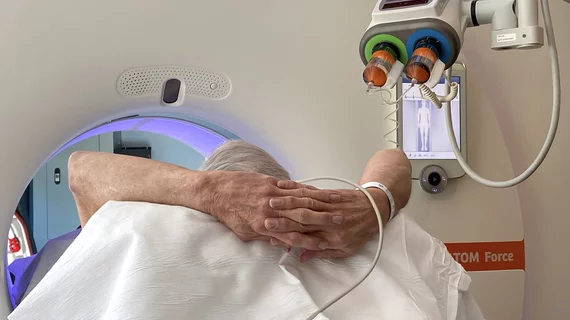
Technologists should not be alone when administering contrast for remote scans, radiology groups are emphasizing in new guidance.
In the recently released 2026 Medicare Physician Fee Schedule, the feds have proposed permanently allowing providers to supervise certain CT and MR exams using video and audio technology. Groups such as the Radiology Business Management Association lobbied to extend this perk—granted in 2020 amid the COVID-19 pandemic—indefinitely, with it set to expire on Dec. 31.
However, professional societies representing both radiologists and rad techs are emphasizing the importance of having a licensed professional on-site in case of an emergency. As proposed, the current MPFS rule does not stipulate this requirement.
“Whenever contrast material is administered, ACR emphasizes that, although a radiologist or other physician may supervise these studies remotely, a qualified licensed practitioner, in addition to the radiology technologist, must be on-site with the technologist in case any contrast reactions occur,” the American College of Radiology said in a statement shared with Radiology Business July 25.
ACR previously issued an official position on remote scanning in February 2024, with the college updating the document on June 12. This came after a meeting of the ACR Drugs and Contrast Committee, attorney and radiology policy expert Tom Greeson wrote in a recent blog post.
The statement allows for on-site, direct supervision of contrast-enhanced imaging studies by a radiologist, other physician or qualified licensed practitioner. However, virtual supervision of the scan should “only be performed by a physician,” ACR contends. This despite Medicare’s proposed rule permitting certain nonphysician practitioners—such as NPs, if state law allows—to supervise contrast administration virtually.
ACR’s statement underlines the importance of having a “licensed practitioner” on-site for the scan, alongside the technologist. But Greeson questioned whether this requirement would defeat the primary benefit of remote-scanning arrangements—allowing for staffing flexibility, with practices only having one professional (besides the technologist) take part in the scan remotely, rather than adding a third party to also oversee contrast administration in-person.
Meanwhile, the American Society of Radiologic Technologists in its own statement also emphasized the need for this additional third participant. ASRT said it “generally supports” CMS’ proposal, when the supervising practitioner is “immediately available” via two-way video conference.
“However, ASRT does have concerns in ensuring qualified healthcare personnel are available to initiate immediate and appropriate treatment, in the event an adverse event occurs during administration of contrast under virtual supervision,” Jason J. Bradley, the society’s VP of governance and public policy, told Radiology Business by email. “ASRT does not support radiologic technologists, except for radiologist assistants, being supervised remotely during the administration of contrast media unless qualified healthcare personnel are physically present. This is important as licensed practitioners and radiologist assistants can provide immediate and appropriate treatment in the event of an adverse reaction. ASRT looks forward to working with CMS to address these specific aspects of the proposal.”
Greeson noted that the ASRT House of Delegates approved this amendment to its standards at its 2025 governance meeting. He called the society update a “devastating blow” to physician offices and independent diagnostic testing facilities who use virtual supervision to meet Medicare requirements. Greeson said state agencies regulating imaging services often cite ASRT practice standards in their on-site inspection reports.
“I fear the consequences of ASRT's recent standards changes,” wrote Greeson, who formerly served as general counsel to the ACR and currently advises radiologists and other imaging providers on legal matters. “Clearly, some radiologic technologists look with disfavor on the virtual supervision of their work by physicians or nonphysician practitioners. But in making this standards change, ASRT may actually threaten the financial viability of many of the imaging centers where they work in states where those standards are part of the regulatory framework. One has to hope that the diagnostic radiology community will unite in supporting CMS' adoption of their new proposed permanent virtual supervision rule. And one hopes that ACR and ASRT will be persuaded rethink their recent statements.”

Marty Stempniak has covered healthcare since 2012, with his byline appearing in the American Hospital Association's member magazine, Modern Healthcare and McKnight's. Prior to that, he wrote about village government and local business for his hometown newspaper in Oak Park, Illinois. He won a Peter Lisagor and Gold EXCEL awards in 2017 for his coverage of the opioid epidemic.