
Wisconsin passes legislation requiring insurers to cover supplemental breast imaging
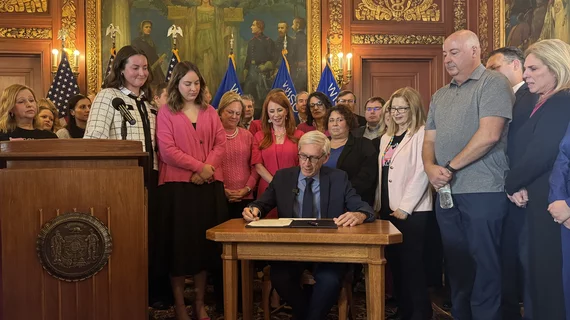
Wisconsin is the latest state to pass legislation requiring payers to cover supplemental breast imaging exams.
Democratic Gov. Tony Evers officially signed Senate Bill 264 into law on March 19 following years of advocacy from the radiology community. While federal legislation has long required insurers to cover regular screening mammograms, that’s not the case for necessary follow-ups such as MRIs and ultrasounds.
Wisconsin locals have dubbed the legislation “Gail’s Law” in honor of Gail Zeamer. The wife, mother and “fierce advocate” for cancer care died in 2024 at the age of 56 after a mammogram missed her cancer, which was masked by dense breast tissue.
“While Gail’s story and influence have helped us make important changes to state law, losing her far too soon due to a late-stage cancer diagnosis should never have been the outcome,” Gov. Evers said in a statement Thursday. “Breast cancer is already one of the costliest cancers to treat, and by making these changes, we’re ensuring no woman slips through the cracks because they weren’t able to afford additional tests not covered by insurance.”
Gail’s Law requires payer policies including Medicaid to fully cover all medically necessary and appropriate supplemental screenings or diagnostic exams. It applies to individuals who are at higher risk of breast cancer or have heterogeneously or extremely dense tissue. Supplemental screening includes MRIs and ultrasounds, used to screen for breast cancer when there is no abnormality seen or suspected based on personal or family medical history. Covered diagnostic exams, meanwhile, include MRIs, ultrasounds, breast tomosynthesis and diagnostic mammograms, used to further evaluate an abnormality seen or suspected on an initial screening. The legislation is expected to take effect on Jan. 1.
The bill also has drawn support from breast care advocacy group Susan G. Komen and the American College of Radiology, among others.
“Thousands of Wisconsinites require diagnostic and supplemental breast imaging every year; yet due to the high out of pocket costs, many forgo these critical services. Not anymore,” Molly Guthrie, VP of policy and advocacy for SGK, said in a statement March 19. “This life-saving legislation ensures they can receive the breast imaging they require, likely leading to earlier diagnosis and better health outcomes.”
Gail’s Law passed following years of advocacy, ACR noted in a news update published March 20. Gregg Bogost, MD, former chair of the Wisconsin Radiological Society Government Relations Committee, recently shared lessons learned from fighting for the legislation. He noted that efforts to pass the bill date to 2017, when Wisconsin also enacted law requiring radiology providers to notify patients about breast density.
“What made the difference in 2025–26 was a combination of stronger political strategy, better data and a better-organized coalition effort,” Bogost told ACR. “In Wisconsin, there has been a strong anti-mandate philosophy for some time, and to overcome that ideological obstacle, the coalition had to work on multiple fronts. But over the years, the political environment also shifted. The new legislative maps in Wisconsin took away some of the components of gerrymandering, and that created more room for moderation.”
Bogost also touted the importance of finding a legislative champion to overcome any obstacles. Rep. Amanda Nedweski, a Republican from Kenosha County, has strong relationships in Madison and “really brought it across the finish line.” Concerns about costs also were paramount. Bogost said at a recent ACR meeting, he learned key data about Maryland’s adoption of a supplemental screening legislation and how it has helped reduce downstream costs through earlier diagnoses.
“Local and national patient advocates brought urgency and authenticity,” he added. “Breast cancer is personal to many people, and once momentum began building, more and more people felt comfortable sharing their own stories or family connections. That emotional connection mattered, but it was most effective when paired with good data.”
About 30 states have now passed supplemental screening legislation, including Alabama earlier this month. Business and insurance lobbying interests, meanwhile, recently combined to derail similar legislation in Kansas. ACR and other medical societies also have fought for a national solution to this issue, the Find It Early Act, on Capitol Hill.

Marty Stempniak has covered healthcare since 2012, with his byline appearing in the American Hospital Association's member magazine, Modern Healthcare and McKnight's. Prior to that, he wrote about village government and local business for his hometown newspaper in Oak Park, Illinois. He won a Peter Lisagor and Gold EXCEL awards in 2017 for his coverage of the opioid epidemic.