
Teleradiologist shares ‘harrowing’ story of being arrested mid-interpretation
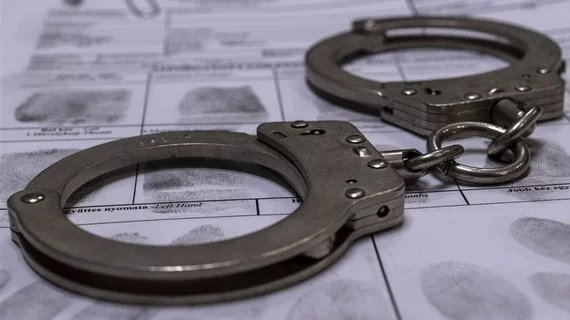
A radiologist is sharing his “harrowing” story of being arrested mid-interpretation after he was caught up in a fraud scheme.
The case dates to December 2017, when an unidentified neuroradiology expert in good standing was pulled off his shift by police, handcuffed and taken to jail. Authorities accused the radiologist of reading ultrasound exams “too quickly,” at five minutes or less per exam, and defrauding the government, since Medicaid claims were involved.
Fellow radiologist Daniel Cousin, MD—clinical director at Bayview Radiology in Fort Lauderdale, Florida—shared the individual’s story in a piece published by KevinMD.com. He has been tasked with auditing the individual’s interpretations for 36 months, a requirement for eventually reinstating his credentials.
“This radiologist has graciously agreed to share his story with our radiologist community with appropriate redactions,” Cousin wrote Oct. 28. “It is my hope that our colleagues may learn from his experiences, be reminded to navigate the complexities of the healthcare landscape with heightened awareness and caution, maintain a delicate balance between trust and vigilance, and be inspired by this radiologist’s perseverance and dedication to recover his radiology career in the face of overwhelming adversity.”
The unnamed individual first started working as a part-time teleradiologist in 2011, driven by a desire to support his family and fund his children’s education. His primary responsibility was remotely interpreting ultrasound scans, collaborating with several imaging groups including one specializing in neurology. Throughout his career, the radiologist has maintained a “clean track record,” with no adverse claims against him.
However, in late 2017, a “startling situation unfolded.” A group of remote rads with which he was engaged was accused of participating in a fraud scheme allegedly orchestrated by the practice.
“It is crucial to emphasize that, as teleradiologists, we had minimal interaction with one another and very limited contact with the practice itself, primarily through email,” the radiologist wrote. “This limited interaction created an environment where the activities of the practice could go unnoticed by us and other doctors.”
He later learned during the case’s discovery phase that the practice had been under investigation since 2015. Reportedly, the group was recruiting patients and obtaining false insurance authorizations using his and other radiologists’ credentials, though primary care docs had legitimately ordered the tests. The practice then fraudulently billed insurance companies including Medicaid using his and other radiologists’ credentials.
What caught the district attorney’s attention was the backlog of unread cases, dating to March 2017, the writer noted. The practice had claimed issues with computer software and delayed uploads by sonographers led to the build-up.
“They also emphasized the urgency, claiming that patients were eagerly awaiting their results and were at risk,” he noted. “Little did I know, this urgency may not have been entirely accurate. Unbeknownst to me, the practice was recruiting and compensating individuals for unnecessary testing.”
Eventually, the practice and ringleaders of the scheme were found guilty of numerous charges including enterprise corruption, grand larceny and healthcare fraud. Practice managers including the owners faced imprisonment. The radiologist emphasized he had no knowledge of the scheme and reaped zero benefits from it. However, after the 2017 arrest, Medicaid imposed an exclusion affecting his professional standing. This had a “cascading effect” on the rad’s professional affiliations, leaving him unable to maintain hospital privileges.
“Furthermore, it is crucial to acknowledge the profound impact this entire ordeal had on my family, my children, my wife and myself,” he noted. “We experienced severe emotional and financial distress due to the prolonged nature of this case due to the COVID-19 pandemic.”
After “enduring several grueling years battling this harrowing situation,” the radiologist and his legal counsel opted to avoid a potential trial. They reached a deal in 2022 to settle the case out of court, which would ensure his medical license would remain intact.
“Despite the settlement, I remain steadfast in my belief that I am innocent of any wrongdoing, and I am eager to move forward and resume my medical practice with integrity and dedication,” he noted.
He said the experience has “underscored the significance of continuous growth and learning.” The radiologist has since immersed himself in 12-week courses focused on ethics and professionalism. This has helped him understand the “delicate balance between trust and vigilance.” The radiologist also in 2019 decided to pursue a musculoskeletal fellowship, reigniting his passion for the specialty. He currently is in the process of seeking Medicaid reinstatement and intends to provide a comprehensive explanation of the circumstances leading up to his 2017 arrest.
“I am committed to ensuring that any misunderstandings or misattributions are addressed appropriately and that I can resume my participation in the program in a lawful and ethical manner,” he concluded. “My journey reinforced the importance of continuous learning and ethics. It taught me to balance trust with vigilance. Sharing my experience is not about vindication but highlighting challenges professionals can face unexpectedly. I am now even more committed to patient care and mentoring the next generation of doctors, ensuring they are ethically grounded. These trials have strengthened my dedication to radiology and advancing medical science.”

Marty Stempniak has covered healthcare since 2012, with his byline appearing in the American Hospital Association's member magazine, Modern Healthcare and McKnight's. Prior to that, he wrote about village government and local business for his hometown newspaper in Oak Park, Illinois. He won a Peter Lisagor and Gold EXCEL awards in 2017 for his coverage of the opioid epidemic.