
400-pound crocodile described as 'a perfect patient' during CT scan
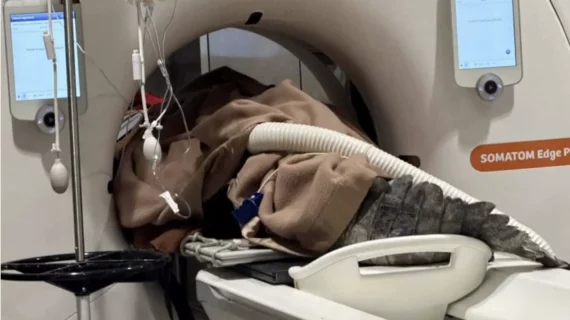
A “lovable” crocodile named Bill is receiving accolades from healthcare staff at University of Utah Health for being “a perfect patient.”
Bill, a 61-year-old Siamese crocodile that calls Utah’s Hogle Zoo home, recently had to undergo advanced imaging due to concerns about his health. The crocodile had been eating less, losing weight and showing signs of abdominal bloating. When his blood work yielded no abnormalities, his team decided they wanted to further explore what might be causing his symptoms.
This led Bill to University of Utah Health’s radiology department for a CT scan of his entire body. The decision took weeks of practicing and planning, in addition to seamless coordination among hospital and zoo staff. More than 20 people were involved in the transport and scan, which required specialized tools and some light sedation to keep the reptile (and his bite force of over 3,000 pounds per square inch) calm for the exam.
Hassan Bourija, radiology supervisor at U of U Health, and Scott Ehrgott, CT technologist at U of U Health, CT, were tasked with scanning Bill, who is 10 feet long.
“Our table is eight and a half feet long, even with the extension, and his tail was still sticking out a little bit,” Bourija explains. “We actually had to flip him around because the CT scanner table can only travel a certain distance. So we had to do the head, neck, and most of his chest and abdomen first, and then flip him around to do the rest of his body.”
Edward Quigley, MD, PhD, professor of radiology at U of U Health, who supervised the scan, created a custom protocol specific to Bill due to his unique body habitus.
“We programmed the radiation dose manually,” Ehrgott says. “For humans, the radiation dose is modulated automatically, but we don’t necessarily have that capability for someone who is much larger and has much thicker armored skin than a human being.”
Bill’s scans revealed stones in his abdomen. While this is common for crocodiles—they ingest stones to aid in digestion—his care team concluded that these were the likely culprit of his issues. He was successfully returned to the zoo after his exam, where he has since started to show some signs of improvement. His team is currently weighing the benefits and risks of a procedure to remove the stones.
Read more here.

In addition to her background in journalism, Hannah also has patient-facing experience in clinical settings, having spent more than 12 years working as a registered rad tech. She began covering the medical imaging industry for Innovate Healthcare in 2021.