
How the shape, size and location of calcified carotid plaques affect stroke risk
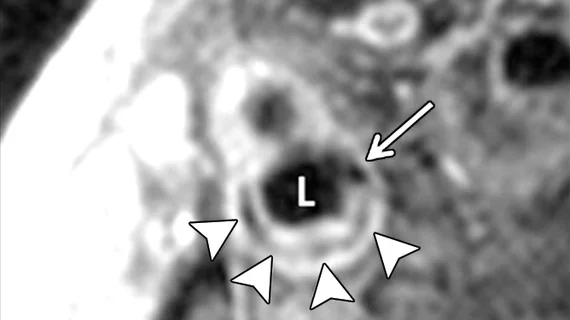
Certain types of carotid calcifications are more likely to trigger an ischemic event, according to new data.
Historically, calcified atherosclerotic plaques were believed to be more stable in nature, making them less likely to break loose and cause a blockage. However, more recent studies have questioned this notion, some of which have indicated that changes in the composition of calcified plaques that occur over time may make them more susceptible to rupture.
Now, a new study in Academic Radiology is providing further insight into factors affecting plaque stability and subsequent ischemic events.
“Mounting evidence indicates that the composition of carotid plaques may have a pivotal role in ischemic events, as it impacts the carotid plaque stability,” Ali C. Akyildiz, MD, with the department of cardiology and biomedical engineering at Erasmus Medical Center in Rotterdam, the Netherlands, and colleagues suggested. “Although calcifications in the carotid arteries are considered to enhance the mechanical stability by stiffening the artery, unlike the ‘softer’ plaque components, they were also shown to potentially increase the risk of plaque rupture by creating localized stress concentration areas within the artery, which depends on the shape, size, and location of the calcification.”
Researchers retrospectively analyzed 128 stenotic carotid arteries from a group of 64 patients who had recently experienced an ischemic event to determine whether certain characteristics impacted the likelihood of such events occurring. The team reviewed patients’ computed tomography angiography exams at baseline and then again after two years, using scans to reconstruct 3D artery and calcification geometries and morphometric assessments.
Upon reviewing the patients’ cases, the group observed temporal changes that correlated with ischemic events. At baseline, symptomatic carotids on the ipsilateral side of the event had more calcifications that were smaller and narrower; they also were farther away from the lumen. At follow-up, the symptomatic side calcifications were smaller in width but had gotten longer in length compared to the asymptomatic side.
“We have observed that the calcifications in symptomatic arteries had a smaller width-to-thickness ratio at follow-up, indicating that the calcification growth was more radial than circumferential in the symptomatic carotids. In line with our finding, calcifications that are elongated in the circumferential direction around the lumen were previously suggested to enhance plaque mechanical stability,” the authors explained. “Ultimately, these calcification metrics could serve as indicators of the risk for ischemic event recurrence, the occurrence of a first-ever event, or even as factors influencing treatment decisions in subclinical populations.”
Learn more about the findings here.

In addition to her background in journalism, Hannah also has patient-facing experience in clinical settings, having spent more than 12 years working as a registered rad tech. She began covering the medical imaging industry for Innovate Healthcare in 2021.