
Dual-energy CT systems allow for significant reduction in contrast dose
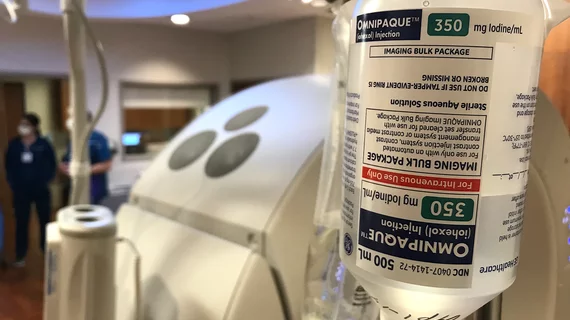
Contrast dose can be reduced by up to 25% during computed tomography pulmonary angiography (CTPA) exams when using dual-energy CT (DECT) systems.
Encouragingly, the reduced dose does not appear to negatively affect the image quality of CTPA exams, according to new research published in Current Problems in Diagnostic Imaging. Authors of the paper suggest their findings could lead to safer imaging protocols that reduce patients’ radiation exposure while also more accurately diagnosing deadly blood clots.
“Computed tomography pulmonary angiography is considered the gold standard in the diagnostic work-up of suspected PE, due to its rapid and noninvasive nature, as well as its wide availability as an imaging modality,” Louise Øksnebjerg Krasniqi, MSc, with the Department of Radiology at Odense University Hospital in Denmark, and colleagues noted. “However, the use of iodinated contrast media requires careful consideration in patients with impaired renal function or thyroid dysfunction, as these conditions may increase the risk of adverse effects," they added later
The use of two different energies in DECT systems gives them an edge over single-energy systems due to their ability to enhance iodine's spectral properties in greater detail. They also allow providers to assess patients’ pulmonary function by analyzing pulmonary iodine distribution through iodine perfusion maps. Combined, these qualities allow for reduced contrast doses during pulmonary studies.
Recently, the team sought to determine the extent to which contrast utilization could be lowered during CTPA exams performed using DECT systems. To do this, they conducted an observational analysis of patients who underwent CTPA with a clinical suspicion of PE between August 2024 and March 2025. Of the 177 participants, 92 completed DECT CTPA exams using 45 mL of contrast media, while 85 patients underwent single-energy scans with 60 mL of contrast. Researchers compared the signal-to-noise ratio and contrast-to-noise ratio for each group, focusing on attenuation in five pulmonary artery segments (main pulmonary artery, left and right pulmonary arteries and right and left posterior basal segmental arteries).
The 25% reduction of contrast in the DECT group did not appear to decrease image quality. In fact, the group determined that the DECT group showed comparable attenuation in all five pulmonary artery segments, plus higher signal-to-noise ratio and contrast-to-noise ratio across all segments. The overall image quality improved without increasing patients’ radiation exposure.
Though the findings related to the use of DECT are promising, especially when considering its growing availability, the group suggested their work can be further enhanced by exploring methods of tailoring contrast doses based on specific patient characteristics.
“Future work should focus on individualized approaches to improve both diagnostic consistency and patient safety. Tailored approaches that account for both patient-specific physiological factors and scanner technique may improve image quality, support renal protection and enhance cost-effective imaging,” they concluded. “This might also reduce variability related to operator experience and procedural workflows.”
Read more about their findings here.

In addition to her background in journalism, Hannah also has patient-facing experience in clinical settings, having spent more than 12 years working as a registered rad tech. She began covering the medical imaging industry for Innovate Healthcare in 2021.