
Low dose GBCA effective, safe for pediatric imaging
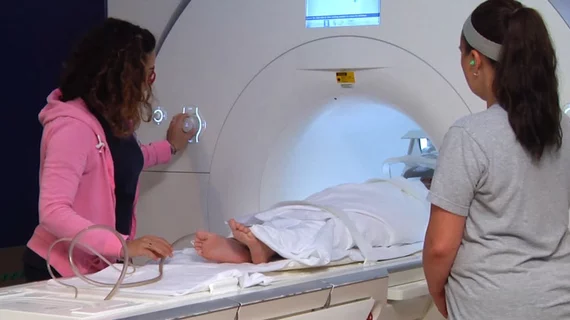
New data supports the use of an MRI contrast agent containing half the dose of gadolinium of standard GBCAs for pediatric imaging.
Published in the American Journal of Roentgenology, the analysis compares gadopiclenol at 0.05 mmol/kg dosing and gadoterate meglumine, which is routinely used in pediatric MRI settings, at 0.1 mmol/kg. Researchers found that gadopiclenol provided the same diagnostic quality imaging as the standard of care, but at half the dose, offering an improved safety profile for children.
“The macrocyclic agent gadopiclenol, FDA-approved in 2022, has relatively high T1 relaxivity, allowing substantial dose reductions,” Camilo Jaimes, MD, with the Pediatric Imaging Research Center at Massachusetts General Hospital, and colleagues noted. MPH “Use of gadopiclenol could facilitate reductions in cumulative gadolinium exposure in children requiring serial MRI examinations.”
Although gadopiclenol is approved for adults and children ages 2 and older, there is limited data on its use in the pediatric population. This has prompted researchers to analyze its efficacy in real-world settings following the agent’s approval.
For their assessment, researchers examined the cases of 38 pediatric patients who had undergone imaging using both agents within a span of six months. Outside of the differing contrast agents used, the scans were exactly the same in field strength and protocol. The group instructed two neuroradiologists, blinded to the type of contrast agent, to assess the imaging and measure the contrast ratio and contrast-to-noise ratio in physiologic enhancing structures (choroid plexus, pituitary, dural venous sinuses, turbinate mucosa).
For gadopiclenol, readers reported higher contrast ratio for the choroid plexus on the 3D T1W fast-spin echo sequence and for visualizing the turbinate on the 3D T1W gradient-recalled echo sequence as well. The contrast-to-noise ratio comparisons did not significantly differ between the agents for any combination of structure or sequence.
However, both readers expressed preference for gadopiclenol for 3D T1W fast-spin echo sequences assessing the choroid plexus and pituitary, while the first reader preferred the lower-dose agent on 3D T1W fast-spin echo imaging of the turbinate. Gadoterate meglumine was the agent of choice for most FLAIR sequences.
Considering the significant reduction of gadolinium in gadopiclenol, the team suggested it could reliably be utilized in pediatric settings, as it has the potential to substantially reduce patients’ cumulative doses.
Gadopiclenol is independently commercialized by both Bracco Diagnostics (as VUEWAY) and Guerbet (as Elucirem), as the companies collaborated on its development. It was approved by the U.S. Food and Drug Administration in 2022, with the first doses being administered in February 2023. The agent is said to have the highest relaxivity of all approved GBCAs, which helps to maintain image quality at the lower dose.

In addition to her background in journalism, Hannah also has patient-facing experience in clinical settings, having spent more than 12 years working as a registered rad tech. She began covering the medical imaging industry for Innovate Healthcare in 2021.