
New MRI technique could make scans more quiet while improving image detail
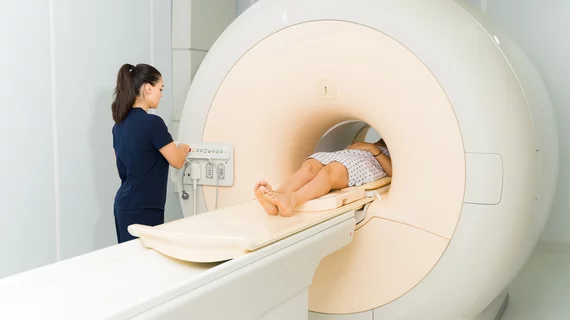
Scientists have developed a new imaging technique that could significantly improve patient comfort during MRI scans.
Researchers with the University of North Carolina at Chapel Hill have created a functional MRI acquisition technique that substantially reduces the noise and interference associated with conventional fMRI. The technique is called SORDINO, which stands for Steady-state On-the-Ramp Detection of INduction-decay with Oversampling. It is an MRI acquisition sequence that changes how the scanner collects measurements used to generate functional brain images, which also happens to make the exams much more quiet.
Its development was led by Yen-Yu Ian Shih, PhD, professor of neurology and associate director of the UNC Biomedical Research Imaging Center. Shih and his team initially developed it for functional brain imaging in small animal models, where conventional MRI noise and electromagnetic interference can complicate experiments.
Through that research, the group determined that its deployment reduced stress-related hormone responses and produced images with less distortion. The improvements allowed researchers to perform fMRI during more complex behavioral experiments, including studies of voluntary movements and social interactions between two mice scanned simultaneously.
The team published their findings on the technique recently in Nature Neuroscience. Although their current work focuses on animal models, researchers believe the technique could eventually contribute to advances in human imaging. Reducing acoustic noise could be particularly useful for studies involving subjects who are sensitive to sound or prone to movement during scanning.
Researchers were awarded a U.S. patent for the SORDINO method in 2024. Though they believe further development will be needed to determine how the technique translates to human imaging applications, they remain optimistic it could help address longstanding challenges in functional brain imaging.
“SORDINO is something we now use regularly in our lab for a variety of neuroscience research projects,” Shih said in a UNC interview. “It has really simplified our day-to-day fMRI experiments. We hope SORDINO will help other researchers overcome some of the technical barriers that have long complicated fMRI studies and eventually bring similar advances to human MRI.”
Read more here.

In addition to her background in journalism, Hannah also has patient-facing experience in clinical settings, having spent more than 12 years working as a registered rad tech. She began covering the medical imaging industry for Innovate Healthcare in 2021.