
Novel urine test reduces need for MR imaging, prostate biopsies
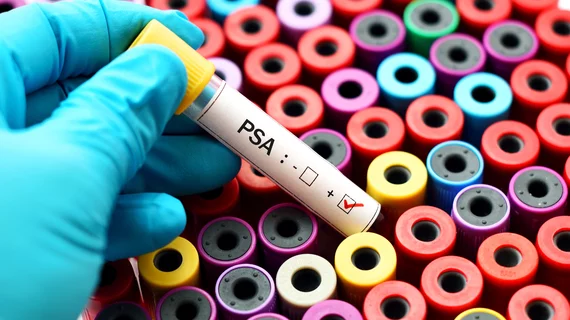
A novel urine test can reportedly reduce the need for MRIs and prostate biopsies, according to new research.
Active surveillance is commonly used in men with low-risk prostate cancer, helping them avoid unnecessary treatment for cases unlikely to cause harm. This entails careful monitoring, experts note, often with repeat prostate biopsies every two to three years to ensure the cancer has not progressed.
However, experts with Vanderbilt Health have developed an assessment called MyProstateScore 2.0–Active Surveillance, which they say performs better than regular PSA-based testing and MRI for monitoring low-risk disease. In an investigation involving over 300 patients on active surveillance, the urine test helped avoid up to 64% of unnecessary biopsies while maintaining timely detection of higher-grade cancer.
“For patients undergoing monitoring of low-grade prostate cancer, these findings suggest that use of the urine test can reduce the need for invasive biopsies without compromising prompt detection of higher-grade cancers that require treatment,” lead author Jeffrey Tosoian, MD, an assistant professor of Urology with the Nashville, Tennessee-based institution, said in a statement May 11.
The analysis found that, in patients previously diagnosed with low-grade cancers and pursuing active surveillance, the urine test correctly predicted the presence of high-grade cancer in 97% of cases. Tosoian and colleagues noted that the test had a 99% negative-predictive value for upgrading cancer cases, meaning there was only a 1% chance of having high-grade cancer detected on biopsy. For most patients, this is low enough to confidently forgo biopsy altogether, Vanderbilt noted.
MyProsateScore 2.0–Active Surveillance provided higher accuracy than MRI for upgrading to both Grade 2 and Grade 3 of the disease, the authors noted. Pre-biopsy urine tests would have avoided 64% of unnecessary biopsies while failing to detect only 3% of Grade 3 upgrades. In contrast, use of Prostate Imaging Reporting and Data System (PI-RADS) scoring would have failed to detect 18% of Grade 3 or greater upgrades and avoided fewer unneeded biopsies (50%). Performance of the novel test was consistent across clinically pertinent subgroups, the authors added.
“These findings suggest that non-invasive monitoring with [the urine test] could reduce the need for scheduled biopsies and serial [multiparametric MRI],” the authors concluded.
The research, which was supported by the National Institutes of Health, was published April 28 in the Journal of Urology.

Marty Stempniak has covered healthcare since 2012, with his byline appearing in the American Hospital Association's member magazine, Modern Healthcare and McKnight's. Prior to that, he wrote about village government and local business for his hometown newspaper in Oak Park, Illinois. He won a Peter Lisagor and Gold EXCEL awards in 2017 for his coverage of the opioid epidemic.