
Scoring system outperforms standard radiology reports for predicting soft tissue tumor malignancy
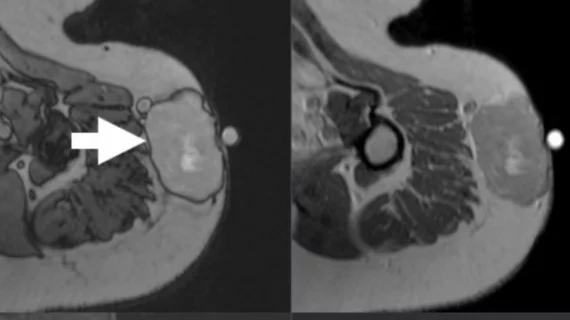
A recently developed reporting system has the potential to significantly improve the diagnosis of soft tissue tumors.
The Soft-Tissue Tumor Reporting and Data System (ST-RADS) is an MRI framework that was designed to assess the risk of soft tissue tumors and help providers in managing the findings. Though histopathology remains the gold standard for diagnosing such tumors, imaging plays a vital role in determining whether patients should be sent for biopsy or excision. The system could prevent patients from undergoing unnecessary invasive procedures, and serve as a viable diagnostic alternative for patients who are not candidates for them.
“Biopsy or surgical excision may not always be feasible due to factors such as lesion location, associated morbidity, and cost,” Avneesh Chhabra MD, with the department of radiology at UT Southwestern Medical Center in Dallas, Texas, and colleagues noted. “Imaging helps distinguish true neoplasms from tumor-like mimics such as hematoma, abscess, and ganglia, etc., by assessing key features including clinical findings and margin definition, internal signal heterogeneity, enhancement pattern, and lesion size. MRI is especially valuable for delineating tumor extent and its relationship to surrounding anatomical structures, which is essential for surgical planning and determining resectability.”
The authors added that radiologists’ accuracy for predicting malignancy of soft tissue tumors using imaging alone sits at around 60%. This is what prompted the development of ST-RADS.
The team recently put the system to the test on more than 200 patients at a tertiary care center with soft tissue tumors visible on MRI. Patient demographics, imaging findings, lesion characteristics, biopsy results, treatments and clinical outcomes were compared alongside the ST-RADS scores provided by readers to determine whether certain factors significantly influenced the scores’ accuracy. The scores also were compared to descriptive reports for each patient.
ST-RADS scores performed well, achieving higher accuracy compared to the descriptive reports, at 99.2% compared to 92.8%. They correlated with biopsy results for nearly 98% of cases, while descriptive reports were in line with histopathological results just 83% of the time. Readers correctly labeled benign tumors 100% of the time when adhering to ST-RADS criteria as well.
These findings indicate that the system could have a productive role in clinical settings, the authors suggested.
“Prospective application of the ST-RADS scoring system demonstrated significantly superior accuracy compared to traditional descriptive methods. These results advocate for broader implementation of ST-RADS in clinical practice as a standardized method for classifying musculoskeletal soft tissue tumors, standardized management recommendations, and longitudinal data collection for tracking patient outcomes,” they concluded.
Read more here.

In addition to her background in journalism, Hannah also has patient-facing experience in clinical settings, having spent more than 12 years working as a registered rad tech. She began covering the medical imaging industry for Innovate Healthcare in 2021.