
Imaging startup announces commercial launch of its portable, wearable breast ultrasound system
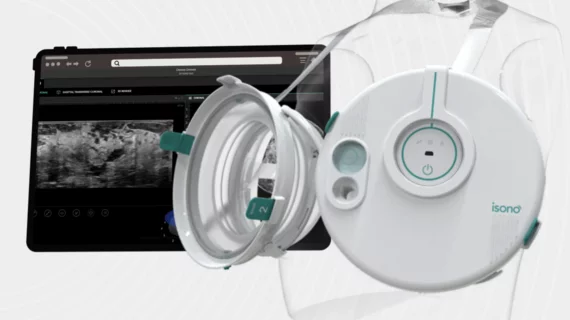
This week iSono Health—a company that specializes in developing solutions catered to women’s health—announced the commercial launch of its wearable breast ultrasound system.
ATUSA is an artificial intelligence-enabled ultrasound device that delivers 3D automated imaging of the breast at the point of care. ISono Health developed the system to address the diagnostic gap between women with dense breast tissue and challenges accessing supplemental imaging. The company believes the product has the potential to address shortages of skills sonographers by putting the easy-to-use technology directly in the hands of providers in clinic.
"ATUSA is a systemwide upgrade for women’s breast health," Neda Razavi, CEO of iSono Health, said in an announcement. "We are putting the power of a world-class radiology suite into the hands of local clinicians, replacing slow, manual workflows with real-time diagnostic images at the point of care."
The portable system can capture full 3D volumes in two minutes per breast, which is approximately 10 times faster than scans completed manually by sonographers. It's shown to offer strong reproducibility, regardless of operator skill level, and it utilizes machine learning to adjust to patients’ needs (based on anatomy) using acoustic biomarkers.
ATUSA was approved by the U.S. Food and Drug Administration in April of 2022. However, in an effort to further improve the technology and increase its utility in clinical settings, iSono is supporting additional research (the AUDIBLE study) to compare the system’s use against mammography and MRI. That study is testing ATUSA’s ability to identify and classify abnormal masses, in addition to further assessing how operator experience affects performance. Leading medical organizations, such as UC Davis, Veda Trials (Axia Women’s Health), and City of Hope are involved in the research.
“What we need are imaging solutions that are easy to use, require minimal training, and can be brought directly into communities,” said John R. Scheel, MD, PhD, MPH, vice chair of global health, department of radiology at Vanderbilt University Medical Center. “Wearable, operator-independent ultrasound technologies have the potential to dramatically improve access, speed, and accuracy, especially for women with dense breasts.”
ISono's announcement also noted the opening of its Series A financing.
To learn more, click here.

In addition to her background in journalism, Hannah also has patient-facing experience in clinical settings, having spent more than 12 years working as a registered rad tech. She began covering the medical imaging industry for Innovate Healthcare in 2021.