
AI model bests radiologists at spotting difficult-to-detect hip fractures
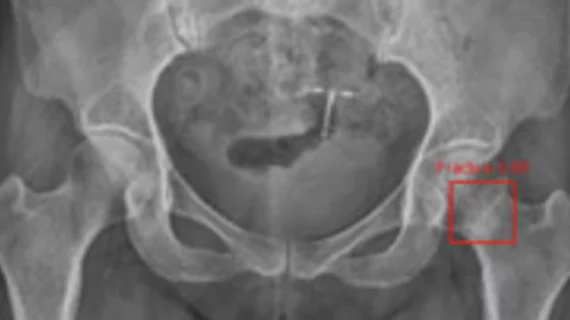
An artificial intelligence-enabled program can outperform both radiologists and emergency medicine physicians at spotting difficult-to-detect femoral neck fractures on radiographs.
A new analysis published in RSNA’s flagship journal Radiology details the development, training and validation of an AI tool known as OccuNet that targets hip fractures. Femoral neck fractures can be particularly difficult to detect on radiographs, with some studies suggesting that up to 10% are missed on initial imaging exams. If such fractures are missed, they can worsen and cause additional injuries that would require more extensive treatments, authors of the analysis warn.
“Radiographs sometimes do not depict femoral-neck fractures, particularly radiograph-negative or indeterminate femoral-neck fractures, leading to delayed treatment and complications,” Nai-Feng Tian, MD, PhD, with the Zhejiang Spine Research Center at the Second Affiliated Hospital and Yuying Children’s Hospital of Wenzhou Medical University, and colleagues noted.
OccuNet was developed using a two-stage approach designed to make the model more robust and sensitive to subtle artifacts and abnormalities encountered on radiographs. During the first stage, the model underwent contrastive pre-training using paired original and artifact-augmented radiographs. The second stage fine-tuned the system to detect fractures. It was tested on 2,576 adults with suspected hip trauma who underwent pelvic or hip radiography followed by CT or MRI during the same episode of care at four hospitals between 2009 and 2025.
In the pooled testing group of 1,766 patients, OccuNet correctly identified 913 of 936 fractures, producing a sensitivity of 97.5%. Its specificity was 98.8%, with 820 of 830 patients without fractures correctly classified. Its performance was particularly noteworthy among the 189 patients whose fractures were initially deemed negative or indeterminate; the model detected 94.7% of these fractures, compared with 86.2% for five musculoskeletal radiologists and 68.8% for five emergency medicine physicians. AI assistance also reduced reading time by 14.9% for radiologists and 18.9% for emergency medicine physicians.
The findings suggest that AI may have a role beyond identifying obvious fractures. By highlighting subtle abnormalities that could otherwise be overlooked, an algorithm could potentially serve as an additional safety net when radiographic findings are indeterminate.
Read more here.

In addition to her background in journalism, Hannah also has patient-facing experience in clinical settings, having spent more than 12 years working as a registered rad tech. She began covering the medical imaging industry for Innovate Healthcare in 2021.