
FDA clears opportunistic AI platform capable of screening for multiple diseases with a single scan
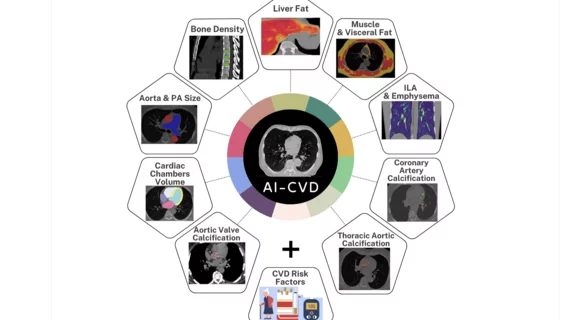
The U.S. Food and Drug Administration recently cleared an artificial intelligence-enabled platform capable of screening for multiple diseases using a single scan.
HeartLung Corporation—a medical software-as-a-service company that specializes in developing early disease detection solutions—announced the 510(k) clearance of its platform on Monday. AI-CVD is an opportunistic, quantitative imaging tool that uses computed tomography images to identify and quantify a myriad diseases.
The platform can be used on virtually any CT scan of the chest and abdomen. It automatically extracts and quantifies cardiovascular and other measurements without additional sequences, radiation exposure, contrast use or workflow disruptions. HeartLung indicates that the platform can be used to identify coronary artery disease, heart failure, atrial fibrillation, stroke, osteoporosis, liver steatosis, diabetes and other adverse health conditions that may warrant follow-up.
It includes 10 FDA-cleared opportunistic measurement domains:
Coronary artery calcium scoring
Aortic wall calcium
Aortic valve calcium
Mitral valve calcium
Cardiac chamber volumetry
Epicardial fat volumetry
Aorta and pulmonary artery sizing
Lung attenuation analysis
Liver attenuation analysis
Bone mineral density and muscle–fat composition
“For decades, medicine has waited for patients to declare disease. AI-CVD allows us to find disease while it is still silent—using scans that already exist,” HeartLung Corp. Founder and President Morteza Naghavi, MD, said in an announcement. “This FDA clearance represents a fundamental shift: CT is no longer just diagnostic imaging—it becomes a scalable, opportunistic prevention platform capable of identifying risk across the heart, lungs, bones, liver and metabolism in a single pass.”
“Modern CT contains far more clinically meaningful information than we traditionally extract,” added David Yankelevitz, MD, a professor of radiology with the Icahn School of Medicine at Mount Sinai and co-principal investigator of IELCAP. “AI-CVD allows clinicians to leverage routine CT scans responsibly and efficiently, without adding imaging burden. That is exactly how opportunistic screening should be done and we are now entering the new domain of comprehensive screening.”
Learn more here.

In addition to her background in journalism, Hannah also has patient-facing experience in clinical settings, having spent more than 12 years working as a registered rad tech. She began covering the medical imaging industry for Innovate Healthcare in 2021.