
Imaging artificial intelligence startup a2z Radiology raises $5M, scores 1st FDA clearance
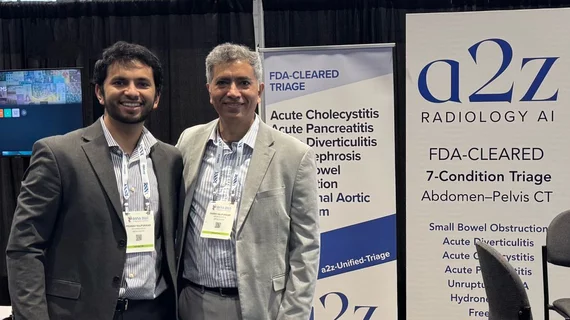
A2z radiology AI, a Boston-based artificial intelligence startup, has raised $4.5 million in funding fresh off scoring its first clearance from the U.S. Food and Drug Administration.
Found in 2024, the company said it’s building the “intelligence layer or medical imaging,” hoping to make radiologist interpretations “accessible on demand.” A2z recently earned authorization from the FDA for Unified Triage, which it believes is the first such multi-condition solution for assessing abdomen-pelvis CT scans.
Bay Area investment firms SeaX and Khosla Ventures participated in the seed funding round, among others. A2z Radiology said it will use the money to accelerate both commercial deployment of its triage system and the development of additional products.
"Radiology is one of the areas that will benefit the most from AI, ensuring no disease goes undetected," Vinod Khosla, a billionaire businessman and founder of his namesake venture capital firm, said in a statement Dec. 9. “While others focus on single conditions, a2z is able to evaluate imaging for a broad range of issues, bringing us closer to the comprehensive capabilities of a real-life radiologist.”
Pranav Rajpurkar, PhD, a Harvard Medical School professor and AI entrepreneur, founded the firm alongside his father Samir Rajpurkar, a technology industry veteran who also launched the Leap Fintech software consulting firm in Dubai. The younger Rajpurkar—a recent Radiology Business Forty Under 40 winner—teaches biomedical informatics at Harvard, with his research focused on AI algorithm development and clinical decision-making. Pranav has written numerous articles on imaging, including recently in Radiology on the need for new “generalist” AI models that move beyond single tasks.
On that front, a2z’s solution can scan for and flag seven urgent findings on CT images of the abdomen and pelvis in one single pass. This region of the body represents the highest volume category for the modality, with over 20 million exams annually, a2z notes. Amid rising case volumes, the company hopes to help radiologists prioritize emergencies “in minutes to ensure faster care for critical patients.” Targeted conditions include small bowel obstructions, gallbladder inflammation, pancreatitis, and unruptured abdominal aortic aneurysms.
"We set out to build a generalist system that could scale across conditions," Pranav Rajpurkar said in a Nov. 26 announcement of the FDA clearance. “We are starting with high-consequence acute conditions, cases where rapid triage can have the greatest immediate impact on patient care."
A2z Radiology also presented initial findings from a prospective study tied to its solutions at the Radiological Society of North America (RSNA) 2025 annual meeting in Chicago. The research demonstrated that AI assistance reduced radiologist reporting time by nearly 18% and “mental demand” by 22%, while also increasing reader confidence by 15%.
The company said it additionally will use the funds to support partnerships with hospital systems, roll out its products in 2026, and develop solutions for more medical conditions.
“We're not stopping at seven. There's still a lot of scaling ahead," said Samir Rajpurkar, who is serving as CEO of a2z.

Marty Stempniak has covered healthcare since 2012, with his byline appearing in the American Hospital Association's member magazine, Modern Healthcare and McKnight's. Prior to that, he wrote about village government and local business for his hometown newspaper in Oak Park, Illinois. He won a Peter Lisagor and Gold EXCEL awards in 2017 for his coverage of the opioid epidemic.