
AI-derived inflammation score improves cardiovascular risk prediction beyond CAC
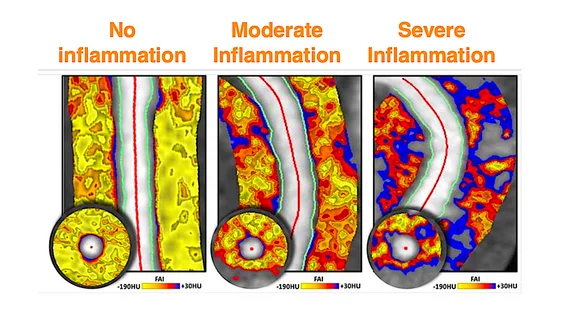
An artificial intelligence-derived measure of inflammation from noncontrast CT shows promise for cardiovascular risk prediction that goes beyond traditional coronary artery calcium (CAC) scoring.
A new analysis in JAMA suggests that these AI-assessed scores could help identify patients at elevated cardiovascular risk even when their calcium levels are low or absent on imaging. The study’s findings indicate that the scores’ prognostic performance is comparable to the established CCTA measures and could offer a way to assess coronary inflammation without requiring contrast-enhanced imaging.
“Zero CAC score is often deemed reassuring and leads to deferral of statin therapy in those at low or borderline risk,” corresponding author Charalambos Antoniades, MD, PhD, of the acute multidisciplinary imaging and Interventional Center at the University of Oxford, and colleagues explained. “However, cardiovascular events frequently arise from the rupture of inflamed, noncalcified plaques, which are not visualized on noncontrast cardiac CT, whereas calcified plaques are generally considered to be stable. Consequently, absent or low CAC does not preclude clinically important residual cardiovascular risk.”
The multicenter study evaluated a novel fat attenuation index (FAI) score derived from noncontrast cardiac CT (NCCT) and compared its prognostic performance with an established FAI measure obtained from CCTA. Researchers included a derivation cohort of 6,818 individuals and an independent clinical outcomes validation cohort of 19,110 individuals who underwent imaging between 2010 and 2021. Median follow-up was 6.7 years.
During follow-up, researchers recorded 536 cardiovascular deaths and 1,727 major adverse cardiovascular events. MACE was defined as myocardial infarction, new-onset heart failure or cardiovascular death.
Both CCTA- and NCCT-derived FAI scores independently stratified cardiovascular mortality risk across CAC categories, with the strongest associations observed among individuals with a CAC score of zero. Including the CCTA FAI score alongside CAC improved the AUC for cardiovascular risk prediction from 0.76 to 0.81; incorporating the NCCT-derived score increased it to 0.80. The additional measures also improved risk reclassification and net clinical benefit across risk thresholds.
The findings were particularly notable among people with no detectable coronary calcium. In this group, cardiovascular mortality increased from 1.4 to 4 per 1,000 person-years among those with FAI scores above the 75th percentile. MACE rates increased from 5.9 to 13.3 per 1,000 person-years.
Among those with CAC scores of zero or between 1 and 99 who died from cardiovascular causes, approximately 45% had NC FAI scores above the 75th percentile, suggesting that inflammation measurements may identify risk that is not captured by calcium burden alone.
The team suggested that their findings present an opportunity for providers to identify more patients who may be at greater risk of CVD without the need for additional resources.
“Because CAC scoring is performed on noncontrast cardiac CT, coronary inflammation can now be quantified from images already acquired as part of routine cardiovascular risk assessment, without additional imaging, radiation exposure, contrast administration, or scan time,” the authors noted. “This could potentially extend coronary inflammation assessment to primary prevention and in patients who are intolerant to iodinated contrast agents, coming as a practical adjunct to routine CAC scoring.”
Though elevated FAI scores may eventually help identify patients who could benefit from more intensive preventive strategies or targeted anti-inflammatory treatments, it should be noted that the findings establish prognostic value rather than demonstrating that FAI-guided treatment improves clinical outcomes. Further research is needed to determine how the measure should be incorporated into clinical decision-making.
Read more here.

In addition to her background in journalism, Hannah also has patient-facing experience in clinical settings, having spent more than 12 years working as a registered rad tech. She began covering the medical imaging industry for Innovate Healthcare in 2021.