
Pigeons excel at spotting abnormalities on CT scans
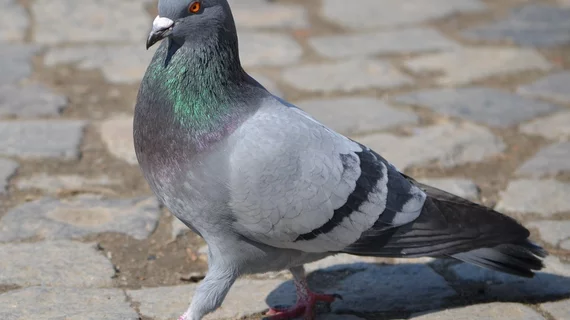
For years, radiologists have been warned that artificial intelligence is coming for their jobs, but a new research project suggests it might be a much more unlikely culprit they need to be leery of—pigeons.
Apparently, the city-dwelling birds have excellent eyesight and can see things that humans cannot. Pigeons have four color receptors in their eyes, while humans have just three; this enables them to see ultraviolet and polarized lights.
While this might give them a visual edge over humans, rest assured that these feathered friends will not be coming for readers’ roles. However, researchers do believe that much can be learned from the birds’ visual processes.
“Accurate detection of pathologies like pulmonary lung nodules is critical as they can be a marker of a potential cancerous, life-threatening condition. The detection of such nodules, however, is a difficult visual task requiring extensive radiological training,” Gregory J. DiGirolamo, PhD, a researcher at the College of the Holy Cross in Worcester, Massachusetts, and colleagues noted. “But, considering this process as a perceptual categorization task generates avenues for using pigeons to understand the underlying visual processes as these birds are experts at categorizing objects and behaviors visually, using a highly flexible and accurate visual cognition.”
To that end, experts recently trained a group of six pigeons to signal when they spotted abnormal growths on videos of CT scans. The team compared the pigeons’ eye movements while looking at the scans to their prior findings on how radiologists’ eyes move and focus while interpreting images. Using a go/no-go paradigm with reinforcement training, half the birds were trained to peck when spotting a lesion, while the other half were taught to peck when an exam showed no abnormalities.
The birds performed quite well, spotting abnormal exams they had not been trained on and eventually signaling when abnormalities that weren’t lesions were present, such as emphysema and ground glass nodules. This, the team contends, is a good example of how pigeons’ perceptual processes enable them to identify more abnormalities than humans, whose conscious perceptions may override nonconscious signals and deem a scan normal.
The study findings could be used in the development of algorithms that monitor gaze-tracking and pupil widening to better train radiologists on spotting subtle abnormalities, the research group suggested.
“These experiments reveal that the complex, attentionally demanding activity of evaluating CT examinations for nodules can be achieved by a biological vision system like the pigeons’, which seems to only use implicit categorization mechanisms,” the team wrote. “These birds may potentially serve as an animal model of biological vision, and like deep learning neural networks, they lack humans’ explicit bias. Given the birds’ success here, some relatively ‘simple’ featural analyses (i.e., by a deep neural network) could be developed to successfully identify abnormalities in CT scans,” they added later.
Read more from the study here.

In addition to her background in journalism, Hannah also has patient-facing experience in clinical settings, having spent more than 12 years working as a registered rad tech. She began covering the medical imaging industry for Innovate Healthcare in 2021.