
In-house radiology 3D printing could slash costs by up to 70% per model
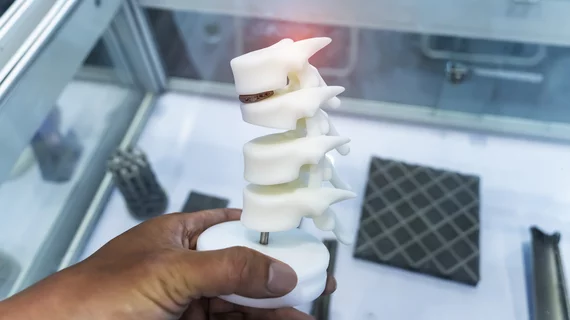
Radiology departments could help reduce their organizations’ 3D printing-related expenses by as much as 70% by keeping printing responsibilities in-house.
The use of 3D printing in medical settings has seen significant growth in recent years. Detailed 3D models can be used for educational purposes, surgical and procedural planning and to inform patients of their condition. Despite the promise of these models, their use remains limited, typically to large academic centers, due to time- and cost-related constraints. Research presented during the annual RSNA meeting suggests that radiologists are well positioned to change this.
“Understanding complex anatomy is critical to practicing radiology and surgery, but access to detailed 3D models is often limited. Commercial models are expensive, have long turnaround times, and are often not tailored to individual patient anatomy,” Kristian Quevada, MD, with Cooper University Hospital in New Jersey, and colleagues noted. “Radiologists have the expertise to implement 3D printing into educational and clinical workflows to provide deeper education and multidisciplinary support.”
Recently, the group sought to determine how in-house 3D printing services led by the radiology department could improve related workflows and reduce expenses. The department purchased a consumer-grade 3D printer for $700, installed the appropriate software and tested its ability to produce accurate models. They first tested the equipment by printing three models: a liver model with Couinaud segmentation for educational purposes, a distal radius fracture model for preoperative planning and an endovascular model for guide wire training.
Through a series of trial-and-error adjustments, the group was able to successfully print accurate 3D models comparable to those printed by commercial companies. Once the kinks were worked out, the group determined that the in-house operations could save organizations significant time and money.
Printing the liver model in-house reduced costs by approximately 72%, while the endovascular model resulted in thousands of dollars saved, with a cost reduction of more than 99%. In terms of time saved, printing the in-house operations saved 40 hours of printing time for the liver model and 88 hours for the endovascular one (there are no commercially available 3D renderings of distal radius fractures available) compared to how long it would have taken to print commercially.
The team estimated that in-house 3D printing on average could produce 70% cost savings per model, in addition to reducing turnaround time by 50%.
“Radiologists’ unique expertise in leading point-of-care 3D printing efforts can improve the quality and cost of trainee education, and aid in multidisciplinary communication. The initial cost of a 3D printer is a scalable investment that pays for itself after just a few prints,” the group concluded.

In addition to her background in journalism, Hannah also has patient-facing experience in clinical settings, having spent more than 12 years working as a registered rad tech. She began covering the medical imaging industry for Innovate Healthcare in 2021.