
Certificate-of-need law forcing referrers to send patients across state border for radiology services
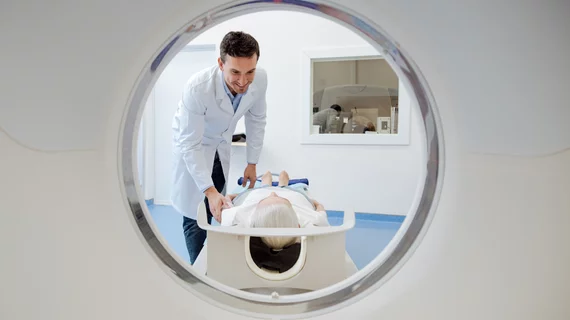
One state’s certificate-of-need law is purportedly forcing referrers to recommend patients cross the border to find affordable radiology services.
Just recently, Lexington, Massachusetts, private practice internist Amy Boutwell, MD, needed to send a patient for follow-up imaging. However, she soon learned Lahey Hospital and Medical Center down the road had a five-month wait for an exam, the Valley News reported Saturday.
Boutwell scoured for a nearby independent imaging center, but her search only turned up a facility 30 miles away in Nashua, New Hampshire. Despite the distance, the Tellica Imaging outpost—part of a chain launched by Utah-based Intermountain Health—had appointments the next day, and at a lower cost.
“I just thought, how’s it possible here in the medical mecca of the world, I don’t have an independent imaging center?” And I didn’t really know why,” Boutwell told the newspaper, referring to Boston and its many world-class healthcare institutions.
The Valley News pointed to Massachusetts’ certificate-of-need, or CON, law as the culprit. Such CON regulations typically require healthcare providers to obtain approval before building a new imaging center or acquiring an MRI machine. These laws are aimed at preventing unnecessary healthcare spending, directing services to underserved areas and protecting existing providers. However, critics contend healthcare providers often wield CON laws to unfairly protect their territory.
Currently, about 35 states have certificate-of-need programs, according to the National Conference of State Legislatures. New Hampshire is the only New England state without one, making it easier for its radiology providers to expand services. Faced with this reality, Salem, Massachusetts, primary care physician Jeffrey S. Gold, MD, is another referrer who has started steering patients to New Hampshire, this time recommending Derry Imaging. The practice reportedly charges about $700 for an MRI, whereas he’s seen some pay $1,500 for the same service in Boston.
Gold believes CON laws have only constrained the free market, with health systems such as Lahey and Massachusetts General already offering imaging. This makes it more difficult for smaller providers to enter the market and compete with hospital giants. One analysis from a George Mason University think tank estimated that imaging providers could have performed over 80,000 MRIs, absent a CON law. However, with certificate-of-need rules in place, they’ve only delivered about 59,000.
Read more from Valley News:

Marty Stempniak has covered healthcare since 2012, with his byline appearing in the American Hospital Association's member magazine, Modern Healthcare and McKnight's. Prior to that, he wrote about village government and local business for his hometown newspaper in Oak Park, Illinois. He won a Peter Lisagor and Gold EXCEL awards in 2017 for his coverage of the opioid epidemic.