
FDA clears first AI-enabled, detector-based spectral CT system
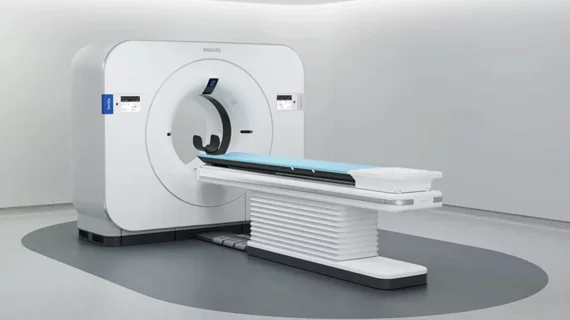
Philips has received 510(k) clearance from the U.S. Food and Drug Administration for its latest computed tomography system.
The Spectral CT Verida system is powered by artificial intelligence, offering users AI-enabled image reconstruction, improved noise reduction (thanks to its Nano-panel Precise dual-layer detector) and enhanced image quality. Due to its detector-based technology, the system’s spectral capabilities are always on, which allows providers to complete spectral imaging without the need for additional scans.
“With FDA clearance for Verida, we are bringing the next evolution of spectral CT to more markets,” Dan Xu, business leader of CT at Philips, said in a statement. “By combining always-on spectral imaging with AI-powered reconstruction, Verida enables clinicians to see more, first time right, supporting faster, more informed decisions and expanding the role of CT across clinical pathways.”
Beyond image quality, the system was designed to support growing workloads as well. Philips maintains that Verida can reconstruct 145 images per second, with the ability to complete entire exams in around 30 seconds; that makes the system twice as fast as others and could allow departments to complete reconstructions on up to 270 exams every day.
It also enables users to complete high- and low-energy acquisitions simultaneously. This gives providers insight into both anatomical and functional data. Plus, it reduces the need for pre-selection or repeat scans, reducing overall radiation exposure.
The Verida system can be used in a range of settings, including diagnostic, interventional, cardiac and oncology for treatment preparation and procedural planning. It also has applications for cancer screening.
Learn more about the system here.

In addition to her background in journalism, Hannah also has patient-facing experience in clinical settings, having spent more than 12 years working as a registered rad tech. She began covering the medical imaging industry for Innovate Healthcare in 2021.