
Radiologists, anesthesiologists and EM docs urge Congress to fix No Surprises Act
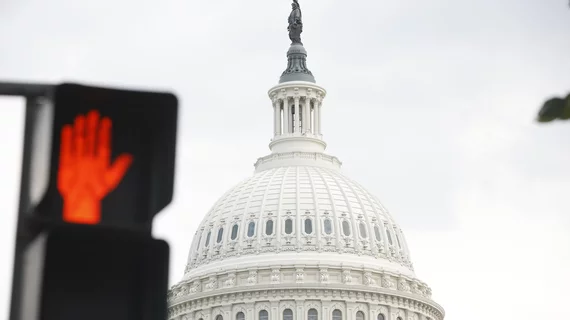
Medical societies representing radiologists, anesthesiologists and emergency medicine are together urging Congress to address problems that have plagued the No Surprises Act.
The three doc groups made their plea in a message to lawmakers, touted on Tuesday. Rads, EM docs and anesthesiologists—three specialties heavily impacted by this issue—contend insurers (and not physicians) are undermining the process meant to protect patients from surprise bills.
To back their claims, the American College of Radiology and others are citing their own analysis of available Centers for Medicare & Medicaid Services data. It shows that insurance companies failed to even participate in the independent dispute-resolution (IDR) process—baseball-style arbitration used to settle disagreements over out-of-network care—about 25% of the time.
“A fair and effective IDR process depends on accurate payment data, transparency and accountability from all stakeholders,” ACR CEO Dana H. Smetherman, MD, MPH, MBA, said in a joint statement from the American College of Emergency and the American Society of Anesthesiologists, shared Sept. 22. “The process has been hampered by insurers refusing to negotiate fair rates, offering inadequate reimbursement and artificially narrowing physician networks, rather than fully participating in good faith.”
Payers are making offers to providers of $1 or less in about 8% of line items, ACR et al. noted. Plus, nearly 40% of insurer offers were either at or below the “qualifying payment amount,” a benchmark, in-network rate for a service, when including defaults. Physician groups contend common questionable payer tactics include “unrealistically low” initial offers, “flawed” QPA calculations and “impractical” contracting terms.
Their message to Congress comes after a controversial article and editorial, published by the Wall Street Journal, claiming providers are “gaming” the No Surprises Act. The report cited CMS figures showing radiologists and other physicians have earned median prevailing offers at about 398% of the qualifying payment amount. However, doc groups have charged that this is the result of artificially low starting offers, which distort the final numbers.
ACR et al. are asking lawmakers to address the “true outlier” payment offers, without allowing insurers to use them as justification for weakening the dispute process. They also are calling on Congress to strengthen enforcement of insurer obligations, scrutinize repeated defaults, and preserve the “balanced IDR framework.”
ACR, ASA and ACEP have previously lobbied for the No Surprises Act Enforcement Act, which would achieve these goals.
“The No Surprises Act must be enforced, not undermined,” L. Anthony Cirillo, MD, president of the American College of Emergency Physicians, said in the joint statement. “Insurers are ignoring the letter and spirit of the NSA. Congress should not look past insurers’ role in driving IDR claim volume and then failing to participate in the process. More can be done to strengthen NSA enforcement and hold insurers accountable when they routinely fail to follow the law.”

Marty Stempniak has covered healthcare since 2012, with his byline appearing in the American Hospital Association's member magazine, Modern Healthcare and McKnight's. Prior to that, he wrote about village government and local business for his hometown newspaper in Oak Park, Illinois. He won a Peter Lisagor and Gold EXCEL awards in 2017 for his coverage of the opioid epidemic.