
Before you sign: What imaging joint venture contracts leave out

Somewhere right now, a radiology chair is reading a joint venture term sheet. It runs 40 pages. It covers capital contributions, distribution waterfalls, governance seats, noncompetes, and what happens if someone backs out. It is a genuinely impressive document.
It says almost nothing about peer review.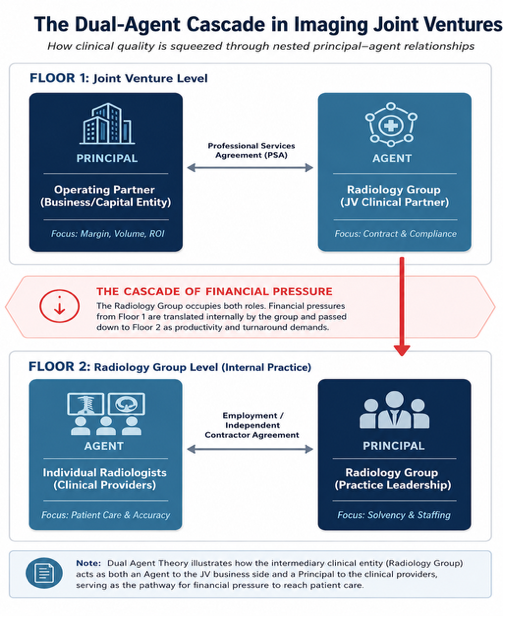
This is not because anyone is behaving badly. It is because the people who draft these agreements are very good at the questions they were hired to answer: who owns what, who pays for what, who decides what, and diagnostic quality is not usually on that list. Quality gets a sentence. Sometimes a paragraph. It is treated as a professional obligation that simply happens, like gravity, rather than as something a contract has to protect.
We spent a while in the joint venture literature, three decades of it, spanning far beyond healthcare, and the pattern that emerges is consistent enough to be uncomfortable. When financial incentives are not structurally separated from clinical authority, diagnostic quality degrades. Not dramatically. It degrades the way a lawn goes brown: slowly, from the edges, while everyone is looking at something else.
The pressure has two floors, not one.
Here is the part that is easy to miss. There are two nested principal-agent relationships in a typical imaging joint venture, stacked on top of each other.
The operating partner contracts the radiology group for professional services. The radiology group, in turn, contracts individual radiologists. Financial pressure applied at the top does not stop at the group; it travels down. A contract renewal tied to throughput becomes an internal productivity target, which becomes an expectation about turnaround.
Peter Drucker's line about culture eating strategy for breakfast is usually quoted approvingly, but it cuts the other way too: A strong quality culture will absorb an enormous amount of misalignment in incentives before it visibly breaks, which means that by the time you can see the problem, it has been there for years.
What to actually ask for
Our framework proposes 13 clinical quality domains that stay with the radiology group as nondelegable authority, and full operational autonomy for the partner, with a co-chaired joint quality committee as the interface. But if you are walking into a negotiation next month, here is the short version of what to fight for.
A volume–quality firewall: No physician compensation, scheduling assignment, or contract renewal decision may be linked to imaging volume. This is the clause. If you win only one, win this one. Expect resistance framed as "we need alignment on productivity." The honest answer is that group-level productivity expectations are fine, and individual-level volume-linked consequences are not.
Physics veto authority: Your medical physicist can withhold clinical release of equipment that fails acceptance testing or drifts below QC thresholds, and no business decision overrides that. Partners often accept this readily once it is explained that the alternative is scanning patients on nonconforming equipment. It is a surprisingly easy win, and groups routinely forget to ask.
A named arbiter: When the two sides disagree about whether something is a clinical-quality matter or a business matter, someone has to decide, and that person should be named in the contract, should be the radiology chair or equivalent, and the determination should be final and nonappealable. Without this, every disputed issue becomes a negotiation, and negotiations are won by whoever has more leverage that quarter.
Escalation thresholds set in advance: We propose seven, calibrated to ACR benchmarks, a 3% image rejection rate, for instance. The virtue of pre-set thresholds is not the numbers themselves but the timing: Agreeing on what constitutes a problem before you have one is dramatically easier than agreeing during.
Teeth: A quality provision without a remedy is a statement of intent. Ours attaches audit rights, defines a reporting cadence, and, for sustained material breach, termination for cause. You will likely never use it. That is rather the point.
The part that helps the business case
None of this has to be adversarial and framing it that way tends to lose the room. The ACR's Diagnostic Imaging Center of Excellence designation offers a useful piece of common ground: an external, credible quality credential that both parties can pursue together, with financial return tied to attaining and maintaining it. Quality stops being the thing radiology asks for and the business side tolerates and becomes a shared target with a scoreboard.
For academic departments, nondelegable assignments preserve the teaching, research and quality infrastructure that the academic mission depends on, infrastructure that is otherwise easy to characterize as inefficiency during a margin review. For private groups, the firewall and noninterference clauses protect clinical independence. For hospital administrators, the joint quality committee provides an accountable oversight mechanism with a real reporting line, which is considerably more comfortable than discovering a quality problem through a malpractice filing.
One honest caveat
This is a template, not a prescription. Joint ventures are heterogeneous, and every element needs local adaptation to the practice model, market, and negotiating leverage. We have not yet validated the framework prospectively against comparator ventures lacking these provisions; that work remains to be done, and we would be the first to say so.
The term sheet is going to run 40 pages regardless. Make sure a few of them are about the images.
Mayur K. Virarkar, MD, MBA, is chief of abdominal radiology and director of quality and research in the department of radiology at the University of Florida College of Medicine – Jacksonville. His governance framework, written with co-author Dheeraj Reddy Gopireddy, MD, MBA, recently appeared in Academic Radiology.