
Turning off daily dormant CT scanners saves money, cuts carbon, rewards teamwork
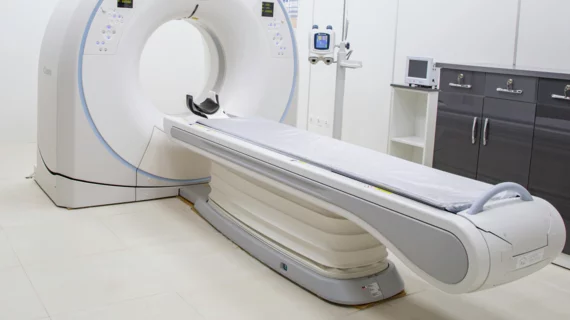
Want to run your imaging operation more cost-effectively while doing a favor for the planet? Just hit the “off” switch on your computed tomography (CT) machines whenever they will not be needed for any appreciable span of time.
So suggest researchers in Australia who conducted a quality-improvement study and found the good habit yields “real and measurable savings” in both carbon footprint and financial costs. And it does so while helping to fine-tune staffing levels.
The savings at individual sites are modest, the team acknowledges. However, when extrapolated across the entire imaging community, “collectively these small changes can make a significant impact toward achieving Net Zero health systems.”
Clinical epidemiologist Katy Bell of the University of Sydney and colleagues had their study published Sept. 21 in the Journal of Medical Radiation Science.[1]
What’s more, the team found the turn-it-off practice proved sustainable over time because project leaders won buy-in from frontline clinicians. As a result, the people using the scanners felt a sense of ownership over the strategy.
Further, imaging technologists and other CT users at numerous locations were “educated and empowered” to follow suit, identifying and switching off their respective “surplus” scanners whenever demand fell off.
A worthy exercise in team-building
For the study, Bell and co-researchers compared seven-day data on power consumption in pre- and post-intervention periods. They found the simple action slashed energy consumption 32%, from 433.96 kWh to 294.17 kWh.
Calculating the effect over a 12-month run, the team estimated savings of 7,280 kWh in energy use and $1,381 to the hospital budget, plus a small but noteworthy 5.5 ton CO2e contribution to the global carbon budget.
Surveyed on the experience afterward, CT operators reported no or trivial impacts on clinical quality from switching off.
Further, the proportion of radiographers reporting switching off the scanner when not in use increased from just 10% pre-intervention to some 80% post-intervention.
“Educating and empowering clinical staff to think about possible downtimes and workloads means that they engage with the initiative and are willing to find and utilize switch-off times for the CT system best suited to their clinical environment,” Bell et al. conclude. “This leads to real and measurable savings in both carbon footprint and financial costs while limiting the downtime to staff and clinical scanning.”
A self-answering climate question
In a separate piece published by The Conversation, Bell and co-author Scott McAlister of the University of Melbourne describe the project in lay terms.[2]
“Medical imaging is one of the biggest contributors to a hospital’s energy use,” Bell and McAlister point out. “Magnetic resonance imaging (MRI) and computed tomography (CT) are particularly carbon intensive, partly due to their need to be constantly cooled. Hospital staff typically leave these machines running 24/7 because they’re often needed for emergency scans.”
“But do all machines really need to be kept on all the time?”
We already know the authors’ answer, but the piece offers a nice summary of the study, which is posted in full for free.

Dave P. has worked in journalism, marketing and public relations for more than 30 years, frequently concentrating on hospitals, healthcare technology and Catholic communications. He has also specialized in fundraising communications, ghostwriting for CEOs of local, national and global charities, nonprofits and foundations.