
Interventional treatment offers 'meaningful' alternative to surgery for osteoarthritis
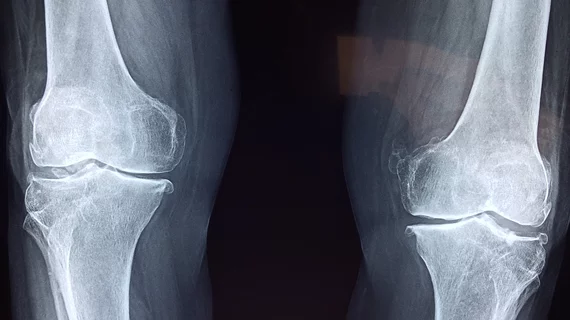
A new technique for an emerging interventional procedure has the potential to slow down the painful joint degeneration commonly seen in knee osteoarthritis.
Genicular artery embolization (GAE) is a minimally invasive procedure that involves embolizing certain arteries that supply blood to the knee joint. This reduces inflammation and pain and allows patients to achieve relief without having to undergo surgery and months of physical therapy during recovery. It has emerged as a promising alternative for osteoarthritis patients who don't respond to intra-articular injections and are not candidates for surgery.
“For many patients with knee osteoarthritis, there is a real treatment gap today,” Florian Nima Fleckenstein, MD, an interventional radiologist at Charité-University Hospital Berlin, said in a news release June 16. “Conservative measures such as intra-articular injections no longer provide sufficient relief, but joint replacement is not an option for medical or personal reasons.”
Multiple studies have highlighted the benefits of GAE as a pain-relieving alternative to injections, medications or surgery. Until recently, researchers had only tested traditional embolic agents and permanent microspheres in GAE procedures; new data published this week in Radiology take these studies a step further by exploring the use of resorbable gelatin-based microspheres.
“By reducing both inflammation and pain, GAE with resorbable microspheres may be the first procedure that alters the course of the disease, slowing its progression,” Fleckenstein noted.
For their study, researchers analyzed the use of resorbable gelatin-based microspheres in 194 patients with confirmed osteoarthritis who did not respond to at least three months of conservative treatment. Each patient underwent at least one procedure with the resorbable microspheres, while around 24% received two rounds of treatment four weeks apart. Outcomes were measured at baseline, six weeks, and three, six and 12 months following the procedure.
Between baseline and 12-month follow-up visits, Knee Injury and Osteoarthritis Outcome Score sub-scores improved significantly. Daily activity scores improved by nearly 20 points, while sports and recreation scores doubled. Scores for osteoarthritis-related symptoms, pain and quality of life all saw substantial increases as well. In total, 80% of participants reported clinically meaningful improvements, with minimal or no side effects.
“This lets us speak about safety and efficacy with real confidence,” Fleckenstein said. “For the right patient, it can mean lasting relief from a single, minimally invasive procedure—a meaningful new option between injections and joint replacement.”
Read more here.

In addition to her background in journalism, Hannah also has patient-facing experience in clinical settings, having spent more than 12 years working as a registered rad tech. She began covering the medical imaging industry for Innovate Healthcare in 2021.