
Robotic-assisted navigation improves accuracy, halves radiation dose during interventional procedures
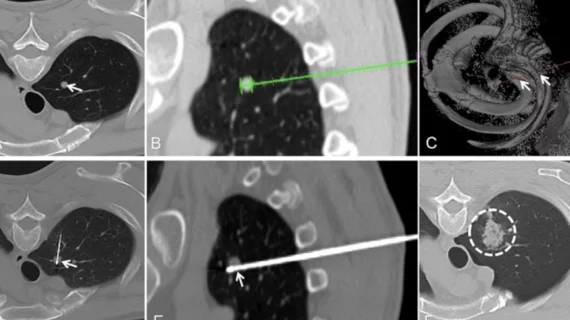
Robot-guided navigation during radiofrequency (RFA) ablation procedures yields significant results for both patients and providers.
Research has shown that patients with lung cancer who are not candidates for surgical resection often benefit from RFA, which uses thermal energy to induce coagulative necrosis in tumors. These procedures achieve control up to 90% of the time in tumors that are less than 3 centimeters.
However, the success of RFA largely depends on the provider performing the procedure, as manual probe placement is critical for accuracy and, thus, patient outcomes.
"Manual probe placement under imaging guidance demands considerable operator expertise. Even in experienced hands, suboptimal probe positioning leads to incomplete ablation margins [occurring] in 15%–20 % of cases. This increases the risk of local recurrence and complications such as bronchopleural fistula or pneumothorax,” Dechao Jiao, with the department of interventional radiology at the First Affiliated Hospital of Zhengzhou University in China, and colleagues explained in the European Journal of Radiology. “Furthermore, the technique’s reliance on freehand placement introduces variability between operators, contributing to inconsistent outcomes.”
In recent years, robotic navigation systems that guide probe placement have emerged as a potential solution. Often integrated with artificial intelligence, these systems have been shown to improve accuracy and reproducibility during interventional procedures. However, their utility in thoracic oncology has yet to be thoroughly tested.
To address this, researchers recently conducted an analysis of 62 patients presenting to their facility for RFA of solitary lung tumors between January 2022 and December 2023. The patients were divided into two groups—one that underwent robotic navigation assisted puncture and one that underwent manual puncture. Researchers reviewed the technical success, puncture scoring, CT scan times, total procedure time, puncture time, radiation exposure, complete ablation rate and local tumor progression rate for each group to determine if robotic navigation offered an edge.
Puncture scoring, puncture time and total CT scan time all improved with the help of robotic guidance; puncture time decreased by around three minutes in the robotic-assisted group, while CT scan times dropped by nearly two minutes, which also led to a notable decrease in radiation exposure (2,215.38 vs. 4,615 mGy). Success rates, total procedure times, major complications and local tumor progression figures were similar between both groups, prompting the authors to lend their support to the use of robotic-assisted navigation during RFAs.
“Our findings demonstrate that [robotic navigation assisted puncture] significantly enhances targeting accuracy in lung tumors, requiring fewer needle adjustments, puncture time intraprocedural CT scans leading to fewer radiation exposure compared to manual procedure,” the team noted, adding: “These gains likely stem from the system’s real-time respiratory motion compensation and AI-optimized trajectory planning with enhanced precision and efficacy.”
Read more here.

In addition to her background in journalism, Hannah also has patient-facing experience in clinical settings, having spent more than 12 years working as a registered rad tech. She began covering the medical imaging industry for Innovate Healthcare in 2021.