
VR teaching tool leads to 'significant gains' in procedural skills for IR residents
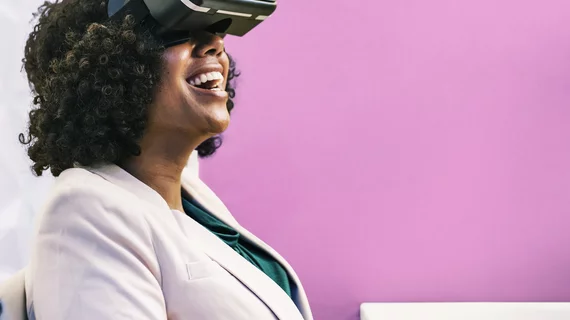
Virtual reality training may help boost radiology residents’ confidence in performing certain CT-guided biopsies.
New data published this week in Academic Radiology detail the utility of a VR training module targeted at improving skills related to CT-guided focal liver biopsy. Experts involved in the analysis believe implementing VR modules that mimic real-life cases could provide residents with additional hands-on experience that will help refine their procedural skills.
“The acquisition of procedural skills has relied heavily on the apprenticeship model, often explained by the phrase, ‘see one, do one, teach one.’ While effective, this approach lacks a structured curriculum and objective assessment tools,” Blaire K. Rikard BS, MMSc-MEd, with the Department of Radiology at Duke University Medical Center, and colleagues noted. “Achieving technical proficiency requires practice and repetition, but gaining early experience with new procedures on patients also raises concerns around patient safety and efficiency.”
To test the utility of VR training, the team divided 18 interventional radiology residents into two groups—one that completed a CT-guided focal liver biopsy VR module and one that did not. Each group took pre- and post-intervention surveys related to their knowledge and confidence in performing the procedure. The VR group also completed additional assessments to gauge their intra-procedural skills during the module.
Based on survey responses, the control group did not display any fluctuations in knowledge or confidence at any time point. The VR group, however, demonstrated “significant gains” after completing the training module. Confidence in ordering steps and completing the procedure showed substantial improvements, as did needle placement accuracy. One month after completing the module, the VR group had maintained their improvements in needle placement accuracy; however, their scan counts and exam times had increased slightly.
“Grounded in the Experiential Learning Theory and gamification principles, the immersive VR module provided learners with a concrete procedural experience designed to enhance retention, while gamified feedback encouraged ongoing learner improvement and engagement,” the authors noted. “By integrating immersive simulation with gamified feedback, the module was effective in promoting procedural knowledge and learner confidence.”
Despite the increased scan counts and procedure times one-month post-intervention, the team suggested their findings lend support to using VR modules as teaching tools to simulate procedural learning.
Learn more about the module here.

In addition to her background in journalism, Hannah also has patient-facing experience in clinical settings, having spent more than 12 years working as a registered rad tech. She began covering the medical imaging industry for Innovate Healthcare in 2021.