
Experts develop first-of-its-kind fully robotic MRI-compatible system for neurosurgery
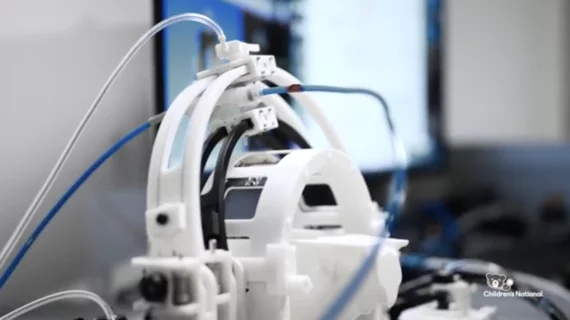
Researchers have developed an MRI-compatible robotic system they say can guide neurosurgery in real-time.
Designed by experts at Children’s National Hospital Sheikh Zayed Institute for Pediatric Surgical Innovation in Washington, D.C., BrainBot was created to provide surgeons with enhanced intraprocedural visualization of the brain. Due to the increased risks associated with exposing children to ionizing radiation, most providers opt for ultrasound or MRI to capture structural and functional imaging of pediatric patients. MRI, however, offers greater detail of the soft tissues in the brain and is preferred over ultrasound in many cases.
BrainBot's development represents a significant step forward in image-guided interventional procedures, as fully robotic devices are not yet MRI-compatible.
“We identified a critical unmet need for a robotic platform that could operate entirely within the MRI scanner,” Reza Monfaredi, PhD, principal investigator and lead inventor of BrainBot, said in a statement.
Monfaredi collaborated with co-leaders Chima Oluigbo, MD, a neurosurgeon at Children’s National and clinical lead, and Kevin Cleary, PhD, associate director at SZI, to develop a system they hoped would be capable of delivering millimetric accuracy under continuous MRI guidance. BrainBot achieves this by allowing surgeons to complete imaging and interventions simultaneously from start to finish.
Some of its features include real-time guidance for planning and adjusting instrument placement without having to reposition the patient, an air-powered automatic needle driver and software that calculates and automates the safest trajectories based on nearby vascular and other sensitive anatomical structures. It also comes equipped with custom 7-channel MRI head coil integration and a modular head fixation system, both of which were designed to ensure procedural functionality and patient comfort.
The system came to fruition, in part, thanks to a $2 million NIH grant in collaboration with Children’s National Research Institute and Cincinnati Children’s Hospital. So far, it has met all necessary pre-clinical milestones, and its team of developers are hopeful that it can soon be tested in human clinical trials.
Learn more about how the system was built here.

In addition to her background in journalism, Hannah also has patient-facing experience in clinical settings, having spent more than 12 years working as a registered rad tech. She began covering the medical imaging industry for Innovate Healthcare in 2021.