
New details surrounding fatal Long Island MRI accident prompt more questions
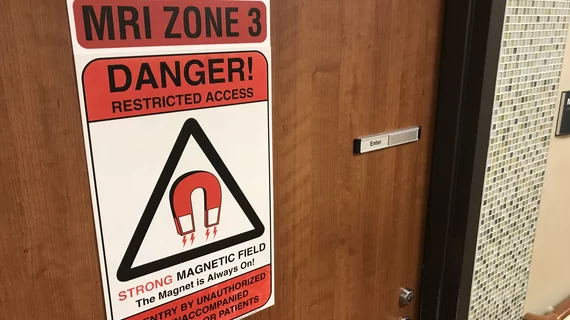
New updates related to the fatal accident that occurred in Long Island in July have prompted more questions about what led to the incident.
Keith McAllister, 61, of Long Island, New York was fatally injured after being abruptly pulled into an MRI scanner by a heavy metallic chain used for weight training. Reports indicate that McAllister was pinned to the scanner by the chain for more than an hour, suffering at least one heart attack during that time. He was rushed to a nearby hospital in critical condition and succumbed to his injuries the following day.
In the wake of the accident, numerous questions still remain unanswered. McCallister was accompanying his wife, Adrienne Jones-McAllister, for an exam of her knee when the incident occurred. She has since shared her experiences with local media and has indicated that the technologist allowed McCallister into the room to help her after her exam. A new development could either corroborate or refute this information.
This week, news of there being video footage of the incident began to circulate. Nassau Open MRI has closed circuit video cameras throughout its facility, including in the control room of the MRI trailer attached to the building where the accident took place. The imaging center requires all patients to sign consent forms acknowledging they are being recorded.
Multiple sources, including MRI safety expert Tobias Gilk, MRSO, have been able to view a one-minute portion of the video. In an update on social media, Gilk details some of what is contained in the footage. He says the video shows McCallister walking from the control room into the scanner suite to assist his wife. During that time, the MRI tech also was in the scanner room on the opposite side of the table.
Gilk notes that the video answers one of the questions that has been posed about the incident with regard to how McCallister entered the room. The footage did not show the tech leaving the room to retrieve McCallister, but suggests he walked from (likely) somewhere in the control room instead. This contrasts with reports that he was escorted into the suite by the technologist.
However, it also raises additional questions: Was he in the control room the entire time? If not, how did he gain access when it was supposed to be secured? If he was allowed into the control room, was he appropriately screened in the same manner his wife was? The snippet also does not provide new information related to how long McCallister was pinned against the scanner, though it can be assumed that the entirety of the video would.
The footage likely will not be released publicly and is assumed to be part of the ongoing investigation into the accident. Gilk says it is important to remember that the majority of MRI accidents that have occurred in recent years have been preventable, but a lack of standardized safety requirements has allowed patients and staff to slip through the cracks.
“The overwhelming majority of MRI accidents are preventable through existing best practices. At present, no existing U.S. state licensure for an MRI facility requires those best practices. No accreditation organization explicitly requires those best practices,” Gilk explains. “That means it falls to the individual provider to decide what they wish to do or to ignore. There is no minimum standard for point of care safety for patients that is enforced by states or accreditation organizations.”
Gilk adds that the accident is yet another reminder of the wide gap between safety recommendations and requirements.
“We need to apply pressure to states, to accreditation organizations. We need to put pressure on CMS to require minimum safety best practices at the point of care,” he urges. “We can stop these types of accidents from happening.”
In the weeks following the accident, McCallister’s family acquired legal counsel and organized a Go Fund Me campaign to cover his funeral expenses.

In addition to her background in journalism, Hannah also has patient-facing experience in clinical settings, having spent more than 12 years working as a registered rad tech. She began covering the medical imaging industry for Innovate Healthcare in 2021.