
New ultrasound needle could significantly improve tissue yield during biopsies
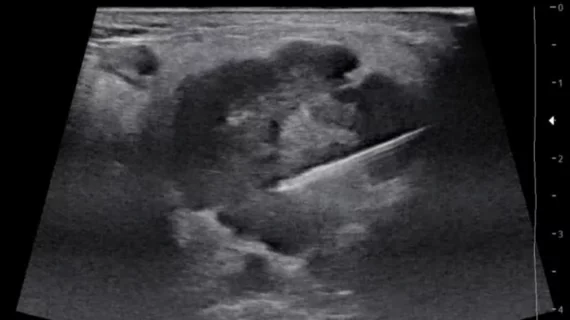
Experts have developed an ultrasound needle that could significantly improve biopsy results, according to new research.
Biopsies often require multiple passes to retrieve enough tissue for laboratory testing. The most commonly used methods are fine needle aspiration biopsy and core needle biopsy. Fine needle uses a smaller needle and collects smaller samples, though multiple passes are usually required; in contrast core needle biopsy uses a larger needle to collect more tissue, but can be more painful for patients and put them at greater risk of complications.
“Both [fine needle aspiration biopsy] and [core needle biopsy] have their shortcomings," explained co-lead author Yohann Le Bourlout, with Aalto University in Espoo, Finland. "FNAB is notably characterized by a high rate of inadequate samples and false benign results. CNB, by virtue of utilizing larger gauge needles, is more invasive, requires more effort to obtain, and is associated with a higher risk of complications, which may necessitate additional preprocedural planning and postprocedural monitoring."
Recently, experts developed a new method—the ultrasound-enhanced fine needle aspiration biopsy—that uses flexural ultrasonic actuation (f ≈ 30 kHz) at the hypodermic needle tip to collect tissues samples similar to those acquired during CNB procedures. Vibrating at up to 30,000 times per second, the ultrasonic needle helps tissue to detach more easily without inflicting a large puncture wound to collect an adequate amount of tissue. Clinical trial results out of Aalto University suggest that the needle could retrieve biopsy sample sizes up to three times larger than currently available tools without additional passes.
“In a clinical setting, such improvements could potentially offer more confident diagnostic conclusions through the sample being better representative of the sampled target and reduce the need for repeat biopsies, optimizing both radiological and clinical workflow, and patient experience,” researchers explained.
A recent clinical study that compared the three techniques yielded positive results with respect to ultrasound-enhanced fine needle aspiration biopsy's utility. The technique produced histological samples between 1.7 and 3.4 times larger than FNAB and CNB, while the sample mass was 1.6 and 3.4 times higher. Importantly, sample quality remained adequate.
So far, the technique has been tested in parotid gland tumors. The team now plans to collaborate with other researchers to explore its utility in thyroid and breast tumors.
"We're excited about exploring the many possibilities," noted Aro. "The clear goal is to improve patient care."
Read more here.

In addition to her background in journalism, Hannah also has patient-facing experience in clinical settings, having spent more than 12 years working as a registered rad tech. She began covering the medical imaging industry for Innovate Healthcare in 2021.