
Wearable ultrasound patch offers continuous monitoring of high-risk pregnancies
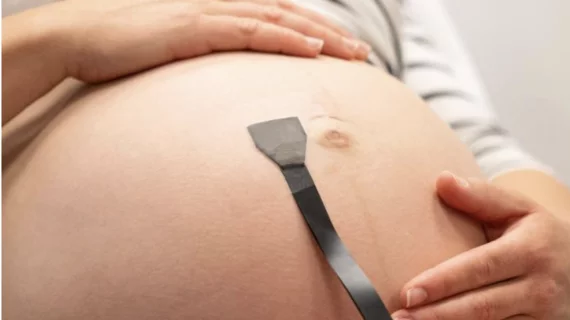
Researchers have developed a wearable fetal ultrasound patch that can continuously monitor high-risk pregnancies for hours at a time.
Though ultrasound is a cornerstone of assessing fetal and maternal health during pregnancy, its utility largely depends on its operator. What’s more, fetal ultrasound exams offer information from a single moment in time, rather than analyzing patterns over an extended timeframe— information that is critical for women facing high-risk pregnancies.
A team of experts from the University of California San Diego are hopeful that their new innovation can help address this issue and potentially improve outcomes for women and their babies.
“Wearable ultrasound technology has the potential to enable continuous prenatal monitoring and improve pregnancy outcomes in ways that were previously not possible,” study co-first author Geonho (Tom) Park, a chemical and nano engineering PhD student at the UC San Diego Jacobs School of Engineering, said in a news announcement.
Park co-led the study alongside fellow UC San Diego Jacobs School of Engineering co-first authors Yizhou Bian, Hao Huang and Sai Zhou. The group believes that the patch can give providers the anatomical and functional data they need to identify critical abnormalities earlier, enabling them to manage pregnancies more proactively.
“To comprehensively monitor mothers and babies over the amount of time needed to catch complications like preeclampsia, you need a system that can work continuously and largely on its own,” Bian added. “That is why the sensing depth, functional capabilities and autonomy of this ultrasound technology are critical.”
One obstacle wearable maternal-fetal monitoring devices run into is the ongoing movement of the fetus and umbilical cord. The patch has been built with algorithms trained to address this movement, allowing it to continuously acquire accurate measurements of blood flow.
“With continuous monitoring, we were able to observe dynamic fluctuations in blood flow that would likely be missed with conventional ultrasound exams,” Huang noted.
In multi-site clinical testing, the device was able to conduct accurate measurements across a variety of patients, matching those acquired by handheld ultrasound probes. Its performance also was maintained across different types of pregnancies, considered both normal and high-risk with complications.
Its use resulted in the early identification of an abnormality that required emergency treatment. The information acquired from its reads allowed doctor to proactively manage the patient's condition, which eventually led to the decision to conduct an early cesarean.
The team is now working to make the device fully effective wirelessly, expanding access to critical monitoring in areas where a skilled sonographer might not be readily available.
Learn more here.

In addition to her background in journalism, Hannah also has patient-facing experience in clinical settings, having spent more than 12 years working as a registered rad tech. She began covering the medical imaging industry for Innovate Healthcare in 2021.