
New survey explores women’s willingness to pay for breast cancer AI
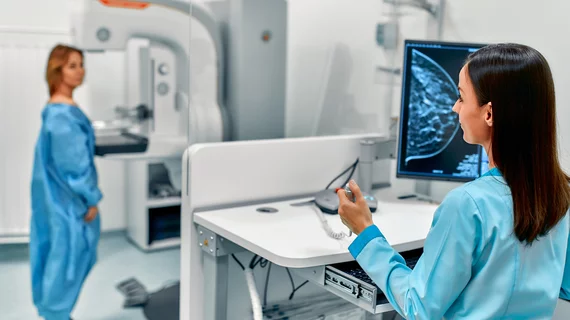
Women are more willing to pay extra for artificial intelligence-powered mammography depending on price point and other factors, according to new survey data.
Radiology providers are increasingly exploring these AI add-ons, inspired by others such as industry giant RadNet. The Los Angeles-based imaging center operator currently charges patients $40 out of pocket for AI-enhanced interpretation, hoping insurers will eventually pony up. Others have since followed suit, including Rayus Radiology and SimonMed Imaging.
Researchers recently explored women’s feelings about this practice, sharing their findings April 4 in the Journal of the American College of Radiology. Some of the results are obvious, with increasing price and dropping AI quality impacting individuals’ willingness to foot this fee.
“Radiology practices may wish to consider these findings when presenting patients with an option to pay for AI interpretation,” Grayson L. Baird, PhD, an associate professor of radiology at Brown University, Providence, Rhode Island, and co-authors concluded.
Researchers recruited women 40 and older who had a prior mammogram to participate in the survey. Questions explored individuals’ willingness to pay for supplemental AI interpretations after being randomized to different price points ($50, $200, $500) and information conditions (no AI information shared, two AI accuracy rates, two AI error rates, etc.) versus a no-AI condition. Those who declined to pay for AI were asked for a reason. Participants were recruited in June and paid $1.25 to complete the five-minute survey.
Altogether, over 2,500 women responded, at a median age of 53. Among the different information conditions, women were more likely to pay for AI when shown an advertisement (27%) or favorable AI accuracy rates (25%). Conversely, they were least likely to pay when shown good (14%) or poor (7%) AI error rates. Among the different pricing conditions, women were more likely to pay for cheaper AI—24% at $50, 17% at $200 and 13% at $500.
Meanwhile, reasons for declining to receive breast AI varied by information condition and price point (i.e., don’t think it’s worth it vs. cannot afford it). Regardless of price, respondents were most likely to say “not worth it” as the reason when presented with the good error rate condition (78%) and least likely when presented with the no information condition (52%). Irrespective of the AI information shared, respondents were more likely to say “not worth it” as the reason for the $50 price point (80%) compared to the $200 (65%) and $500 (56%) price points. Respondents also indicated a greater willingness to pay for AI when there were higher specificity (98% vs. 93%) and lower false positive rates (84% vs. 95%).
“Moreover, the presentation of accuracy rather than error metrics also generally yielded greater willingness to pay for AI, a finding consistent with psychological research demonstrating the value of framing decisions under uncertainty in terms of positive versus negative outcomes,” the authors wrote.
However, Baird and colleagues also noted the potential benefits of disclosing AI error rates. Such transparency could help to reduce legal exposure for radiologists, hospitals and AI software vendors. Previous research has suggested that informing individuals about false positive rates can “lower the risk of emotional harm from incorrect diagnoses, potentially decreasing the likelihood of legal action,” the authors added.
“Even when lawsuits occur, providing information on AI’s limitations may make them less successful,” they wrote.
The study also found lower trust among patients when AI alone was used but still a desire to pay for AI. This, the authors noted, suggests participants want access to new technology but they “do not want to trade out the human component.”
“Practices that ask patients to pay for AI at the time of service are putting their use of AI front and center. However, it supports all practices that use AI to educate patients on the benefits of AI as it will increase patient trust and also demand for this new technology,” Baird et al. wrote. “It is also noteworthy that patients did not trust a radiologist who uses AI more than a radiologist who does not use AI. If, as shown in prior work, AI enhances a radiologist’s performance, it would be helpful for patients to be aware of this information.”
Read more, including potential study limitations, in JACR.

Marty Stempniak has covered healthcare since 2012, with his byline appearing in the American Hospital Association's member magazine, Modern Healthcare and McKnight's. Prior to that, he wrote about village government and local business for his hometown newspaper in Oak Park, Illinois. He won a Peter Lisagor and Gold EXCEL awards in 2017 for his coverage of the opioid epidemic.