
10-second brain MRI scans possible with newly FDA-cleared deep learning reconstruction software
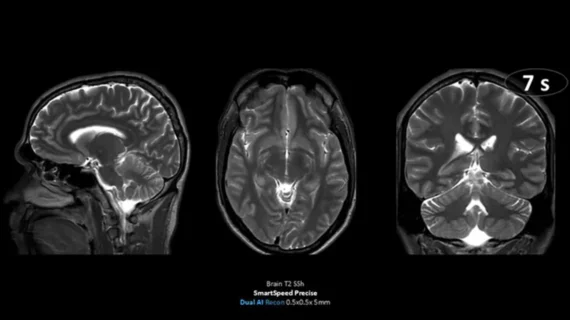
Philips’ latest deep learning reconstruction software was just granted 510(k) clearance by the U.S. Food and Drug Administration.
The health tech giant says its SmartSpeed Precise MR software marks “a major milestone in the journey toward autonomous, personalized MRI.”
“This FDA clearance is a powerful validation of Philips’ leadership in AI-powered MRI innovation,” Ioannis Panagiotelis, PhD, business leader MR at Philips, said in an announcement. “SmartSpeed Precise reflects our commitment to continuous innovation that addresses clinicians' real-world pressures.”
The artificial intelligence-enabled software offers accelerated acquisition times, improved image resolution and one-click workflows for technologists. Philips says SmartSpeed Precise helps technologists complete many scans up to three times faster; routine brain scans can be completed in as little as 10 seconds, while breast MRI acquisition times can be reduced by 50%.
Image quality also gets a boost from the new software. Its deep learning denoising techniques improve image sharpness by up to 80% and its protocol optimization capabilities increase the consistency of image quality. This feature helps ensure diagnostic quality imaging can be achieved across varying patient anatomies and technologist experience levels.
“By integrating dual AI with our proven Compressed SENSE engine, we are enabling faster, sharper, and smarter MR scans—making high-quality imaging more accessible and efficient than ever before,” Panagiotelis said.
“SmartSpeed Precise helps us do what was previously thought impossible—deliver sharper, faster MRI with less effort,” added Julian Luetkens, MD, professor of radiology at University Hospital Bonn in Germany. “In breast MRI, we saw acquisition times reduced by up to 50%, with image quality improving compared to previous Compressed SENSE protocols. That’s a game-changer.”
The software is available for installation on all new Philips MR scanners and across all previously installed base models of its 1.5T and 3.0T MR systems. The upgrade does not require additional hardware.
Learn more here.

In addition to her background in journalism, Hannah also has patient-facing experience in clinical settings, having spent more than 12 years working as a registered rad tech. She began covering the medical imaging industry for Innovate Healthcare in 2021.