
Society of Interventional Radiology shares guidance on offering new image-guided service
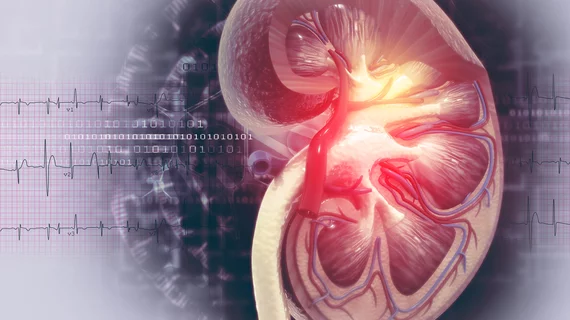
The Society of Interventional Radiology is sharing new guidance to help IR specialists bolster offerings for patients with renal disease.
Hemodialysis, removing waste and excess fluid from the blood when the kidneys are unable to, is a major source of patient morbidity and mortality, along with costs to the healthcare system. Interventional radiologists can play a key role in kidney care, SIR notes, using a novel, nonsurgical approach that deploys catheters and imaging guidance to create a fistula in the arm for dialysis access.
With the emergence of this technique, the society recently convened a workgroup to offer interventional radiologists guidance on performing these percutaneous arteriovenous fistula, or pAVF, procedures. They shared their findings in a paper published Tuesday by the Journal of Vascular and Interventional Radiology.
“A durable hemodialysis access fistula has been shown to reduce morbidity and improve [end-stage renal disease] patients' quality of life,” SIR President Robert A. Lookstein, MD, said in a statement from the society Sept. 9. “By emphasizing the important role that interventional radiologists play in the longitudinal care of dialysis patients, including hemodialysis access fistula creation, this guideline helps ensure that IRs are recognized as vital members of the patient care team, which will be foundational to improving patient outcomes."
SIR’s document offers details on how to select patients for the image-guided procedure, managing complications and handling follow-up care. It also explains how interventional radiologists can work to build a pAVF program, with many hemodialysis patients receiving their access care in outpatient facilities such as office-based labs and ambulatory surgery centers. Communication with referring physicians is essential, the society noted, with many ways to foster these relationships.
Prior to developing a program, an IR group should understand the needs of its community, the authors emphasized. Building relationships with nephrologists is essential, and sufficient time must be devoted to patient and provider education. Maintaining relationships with access surgeons, along with hemodialysis centers and their staff, also is invaluable.
At some IR programs, patients can undergo vascular mapping and have their access point created on the same day. Such timely hemodialysis establishment often is compelling for nephrologists, who value reduced dwell times. While not essential, the authors added, a dedicated anesthesia provider can facilitate appropriate sedation and nerve blocks. Emphasizing a “patient first approach will help to ensure the success of an outpatient pAVF practice and facilitate patient satisfaction.”
Such programs can represent a new revenue stream for the hospital, though many institutions may be constrained in their ability to promote, market or assist in practice-building. Some hospitals also may see pAVF programs as competing with surgical hemodialysis access procedures, a challenge overcome by demonstrating the value of this new offering, according to the society.
“Another challenge is gaining approval for purchase of pAVF devices through a formal value-based analysis committee where cost, reimbursement, and benefits must be explained,” the authors advised. “Finally, patients may experience higher out-of-pocket costs at the hospital than in nonhospital outpatient settings due to differences in reimbursement.”
The guidance offers details on coding, billing and reimbursement, with these procedures paid for in a variety of settings under Medicare rules. For patients with private health insurance, coverage policies should be reviewed, as some payers currently deem these methods as investigational or experimental. The Society of Interventional Radiology has created an advocacy page on its website, which will be periodically updated to aid with prior authorizations and claim denials.
“Medicare and insurance companies have had inconsistent reimbursement policies that make the development of a pAVF program in the United States financially challenging,” according to the guidance. “Fortunately, the recent work of our medical societies has led to the assignment of CPT codes and relative value units (RVUs) that help address the cost of procedures and reimbursement to providers.”

Marty Stempniak has covered healthcare since 2012, with his byline appearing in the American Hospital Association's member magazine, Modern Healthcare and McKnight's. Prior to that, he wrote about village government and local business for his hometown newspaper in Oak Park, Illinois. He won a Peter Lisagor and Gold EXCEL awards in 2017 for his coverage of the opioid epidemic.