
Society of Interventional Radiology endorses treatment for symptomatic knee osteoarthritis
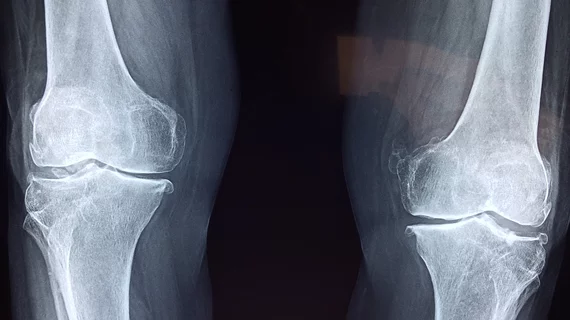
The Society of Interventional Radiology has endorsed a key emerging treatment for symptomatic knee osteoarthritis, according to a new position statement published Monday.
SIR said it supports the use of genicular artery embolization, a minimally invasive treatment that addresses pain. First described in the medical literature in 2014, the procedure uses a catheter to inject particles that block abnormal, pain-inducing blood vessels to provide immediate and long-term relief.
Experts see enormous potential in the delivery of genicular artery embolization, with millions impacted and growing case numbers given an aging population.
“Knee osteoarthritis (KOA) is a prevalent musculoskeletal condition characterized by a significant therapeutic gap between the failure of conservative medical therapies and surgical arthroplasty,” Osman Ahmed, MD, a professor of radiology with the University of Utah, and co-authors wrote May 11 in the Journal of Vascular and Interventional Radiology. “Genicular artery embolization has emerged as a targeted, joint-preserving vascular intervention performed by interventional radiologists that directly addresses the inflammatory and neurovascular components of KOA,” they added later.
Ahmed and colleagues noted that the body of literature has demonstrated the procedure’s safety, technical feasibility and clinical effectiveness. The latter includes research showing “significant and durable reductions” in pain scores, along with tangible improvements in patients' functional status. However, broader adoption of GAE and consideration for inclusion in multispecialty clinical guidelines will require the continued generation of high-quality evidence, including randomized studies, experts noted.
“These studies are essential to definitively isolate the physiological treatment effect from the placebo response and to establish comparative effectiveness against existing conservative therapies, such as intra-articular corticosteroid injections,” the authors wrote. “Concurrently, regulatory bodies, including the U.S. Food and Drug Administration, have used specific pathways to facilitate the investigation of these devices for this emerging indication.”
Ahmed et al. noted that—with nonsurgical options for knee osteoarthritis limited—the FDA has granted its Breakthrough designation to five different embolic platforms. This will help prioritize the regulatory review process for upcoming investigational device exemption trials. However, despite this momentum, none of these embolic agents currently hold a formal FDA indication for musculoskeletal procedures. Thus, in the U.S., their delivery for knee pain “remains off-label,” the authors added. This while European and Canadian regulatory landscapes have “already reached a formal turning point,” granting certification to some of such agents.
“In sum, converging clinical data, global adoption, and evolving regulatory frameworks position [genicular artery embolization] not as an experimental intervention but as an established treatment option for [knee osteoarthritis]—one whose role in standard practice will be further defined by the next generation of randomized and registry-based evidence,” the authors concluded.
SIR emphasized that genicular artery embolization should be delivered by interventional specialists with formal training and advanced experience in microcatheter work. The society also emphasized that the procedure should be performed within multidisciplinary care pathways and reported using standardized outcome measures.

Marty Stempniak has covered healthcare since 2012, with his byline appearing in the American Hospital Association's member magazine, Modern Healthcare and McKnight's. Prior to that, he wrote about village government and local business for his hometown newspaper in Oak Park, Illinois. He won a Peter Lisagor and Gold EXCEL awards in 2017 for his coverage of the opioid epidemic.