
Imaging experts 3D-print specialized MRI sensors at fraction of standard cost
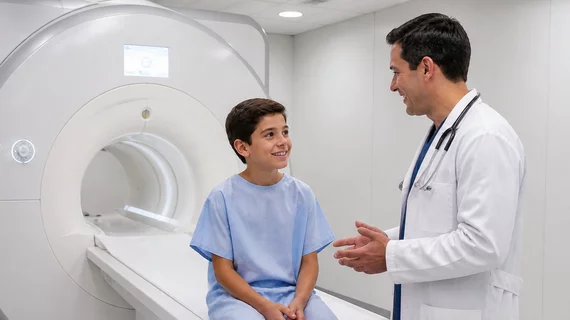
Imaging experts with the University of Southern California are championing a new cost-saving approach to treating some of the smallest and most vulnerable patients.
Scanning an infant’s tiny heart can be difficult, given that much of the MRI equipment comes in standard sizes for adults. Customized sensors can cost thousands and take months or years to make.
However, USC experts have now developed flexible MRI sensors that can be tailor-made for individual patients. They are 3D printed at the school’s labs in less than 10 minutes and cost just $30. Testing showed they can produce roughly four times greater image contrast than standard commercial sensors. This allows docs to capture anatomy in motion, including a tiny, fast-beating heart.
“By making customized MRI equipment faster and more affordable to produce, we have the potential to bring better imaging to patients who have traditionally had fewer options, especially infants and children,” said Yasser Khan, PhD, assistant professor of electrical and computer engineering and biomedical engineering at USC, said in an Aug. 11 announcement from USC.
MRIs utilize coils that act like antennas to pick up signals from the magnet. The closer they come to the patient being scanned, the clearer the image, USC notes. This is especially critical for small patients, with adult coils leaving critical gaps that make it harder to capture a strong signal. Rapid growth also means providers will continue needing new coils to scan pediatric patients.
After three years of experimentation, Khan and his team came up with the in-house 3D process. It involves printing conducive silver ink onto a thermoplastic elastomer—a soft, stretchy material with properties similar to human skin. Since they were designed digitally, researchers can easily adjust their shape and size on a computer and print another coil.
The innovation was the result of collaboration across disciplines and areas of expertise at USC.
“We need environments where different ideas can collide,” Khan added. “This project wouldn’t have happened without access to the MRI and conversations with cardiologists, radiologists and imaging scientists. When you bring that expertise together, you can solve problems none of us could solve alone.”

Marty Stempniak has covered healthcare since 2012, with his byline appearing in the American Hospital Association's member magazine, Modern Healthcare and McKnight's. Prior to that, he wrote about village government and local business for his hometown newspaper in Oak Park, Illinois. He won a Peter Lisagor and Gold EXCEL awards in 2017 for his coverage of the opioid epidemic.