
MRI safety guidelines may fall short for patients with implanted electrode cuffs
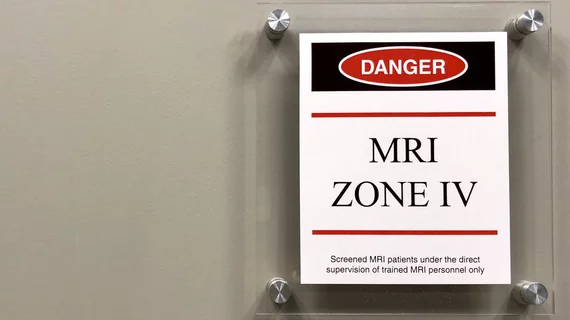
Researchers from the University of Houston caution that certain implanted electrode cuffs could cause inadvertent stimulation of the nerves during MRI scans.
Electrode cuffs are implanted devices used for nerve stimulation in cases of pain, epilepsy and other inflammatory or neurological conditions. Updated versions of these devices are considered MRI conditional as long as certain precautions are followed (these are dependent on the specific device, scanner, area of interest and protocol). However, new data suggest that MRI safety protocols might fall short when it comes to ensuring patients avoid adverse side effects.
Published in the journal Magnetic Resonance in Medicine, the new analysis indicates that fast-switching gradient coils and radio frequency coil-induced heating near the cuffs could trigger unintended vagus nerve stimulation during MRI exams.
“This suggests that current MRI safety guidelines may not fully account for implanted nerve cuffs, and that more refined guidelines and careful safety considerations are needed,” lead researcher Ji Chen, PhD, a professor of electrical and computer engineering at UH, explained.
To get a better idea of how the cuff electrodes behave during MRI exams, Chen and team conducted electromagnetic, thermal and neurophysiological simulations to quantify activation thresholds under MRI-induced fields. They analyzed the effect of gradient field exposure and RF-induced heating, paying close attention to the impact of the trapezoidal waveform of the gradient coil with short pulse duration on the electrodes.
Through this, the group determined that the presence of the cuff significantly reduces the activation threshold under gradient field exposure. This was further exacerbated under RF-induced heating with short pulse durations. Concerningly, in some cases, the activation thresholds were below defined peripheral nerve stimulation limits—something the team suggested should be considered when developing imaging protocols for patients who have the specified implanted devices.
“For RF-induced heating safety assessment, multiple human body models, more imaging landmarks, more implantation pathways, and different polarizations should all be considered,” Chen said.
The group acknowledged that more research is needed to further refine appropriate threshold limits and optimize protocols to reduce the risk of unintended nerve stimulation. He and his team are conducting additional analyses on how to better mitigate these risks.
The study abstract is available here.

In addition to her background in journalism, Hannah also has patient-facing experience in clinical settings, having spent more than 12 years working as a registered rad tech. She began covering the medical imaging industry for Innovate Healthcare in 2021.