
Theranostic pair shows promise for diagnosing and treating kidney cancer
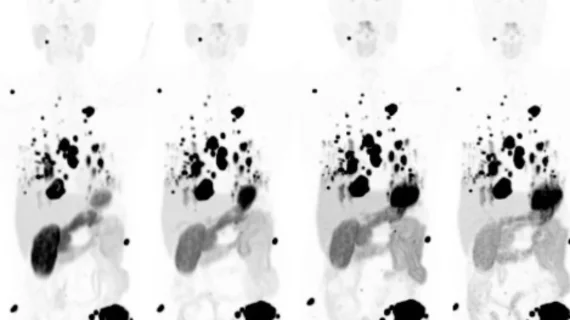
A newly developed theranostic pairing has the potential to improve both the diagnosis and treatment of metastatic clear cell renal cell carcinoma (ccRCC), according to research published in The Journal of Nuclear Medicine.
The paired agents 68Ga and 177Lu-NYM096 target carbonic anhydrase IX (CAIX), an enzyme that is highly expressed in the most conventional type of renal cell carcinoma. The compound can be labeled with either gallium-68 for PET imaging or lutetium-177 for targeted radionuclide therapy, allowing the same molecular target to be used to identify tumors and subsequently deliver radiation.
“My colleagues and I developed a new generation of small molecule compounds that target carbonic anhydrase IX (CAIX) enzymes which are overexpressed in [clear cell renal cell carcinoma],” Wenjia Zhu, MD, associate professor in the Department of Nuclear Medicine at Peking Union Medical College Hospital in Beijing, China, explained. “These compounds allow for radiolabeling with both diagnostic and therapeutic radioisotopes to more precisely—and safely—deliver treatment to patients."
Researchers first evaluated the agents in renal cell carcinoma tumor-bearing mice before conducting human studies in patients whose metastatic disease had progressed after standard treatment. Patients underwent serial whole-body 68Ga-NYM096 PET/CT to assess tumor uptake, biodistribution and radiation dosimetry. Those with positive CAIX expression then received 177Lu-NYM096 using a standard dose-escalation design.
In animal models, both agents demonstrated high tumor uptake, while 177Lu-NYM096 produced dose-dependent tumor suppression. The early human data mirrored these results, showing similarly high uptake of 68Ga-NYM096 in metastatic tumors. Follow-up 68Ga-NYM096 PET/CT scans also showed evidence of tumor response following 177Lu-NYM096 treatment, supporting its use for a theranostic strategy.
Treatment with 177Lu-NYM096 produced no evidence of nephrotoxicity, hepatotoxicity or pancreatic toxicity. However, the team observed some gastric toxicity, indicating a need to further evaluate radiation exposure to the stomach in order to optimize the treatment approach.
“Our imaging agent identified tumors with very high uptake, and our early clinical experience suggests that targeted radiotherapy may offer a new treatment strategy for selected patients,” noted Li Huo, MD, director of the Department of Nuclear Medicine at Peking Union Medical College Hospital. “This study provides the first human evidence of both the promise of this approach and highlights an important challenge—radiation to the stomach—that will help guide the development of safer future treatments.”
Read more here.

In addition to her background in journalism, Hannah also has patient-facing experience in clinical settings, having spent more than 12 years working as a registered rad tech. She began covering the medical imaging industry for Innovate Healthcare in 2021.