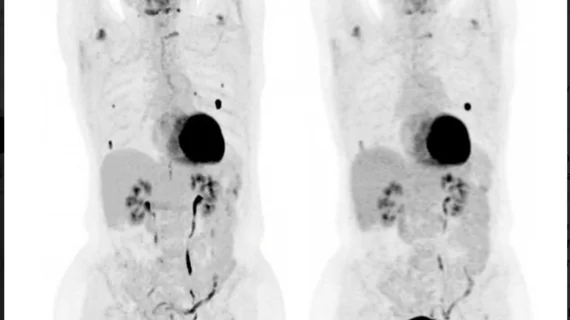
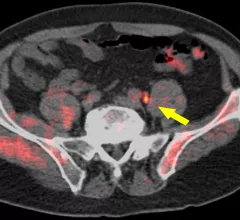
Positron emission tomography/computed tomography is a hybrid nuclear medicine imaging technique that helps radiologists spot abnormal metabolic activity. PET/CT is commonly used to diagnose cancers, heart diseases and certain brain disorders, among other conditions.
Though both modalities offer providers insight into the extent of a patient’s disease, WB-MRI may be more beneficial for patients than the current standard of care.
Though these treatments are typically done with assistance from real-time fluoroscopy, there is ample evidence nuclear imaging may offer more benefits.
Currently, the organization relies on a mobile PET unit that parks once every week. However, demand has grown for PET/CT in the area, rising by around 60% over the last three years alone.
The research focused on a radiopharmaceutical that contains the isotope zirconium 89, which has a significantly longer half-life compared to gallium-68-labelled PSMA ligands.
A comparison of the detection rates for 68Ga-PSMA PET/CT and mpMRI in low, intermediate and high-risk prostate cancer was recently shared by experts in EJNMMI.
Such scans determined the final diagnosis in 54% of patients and were more accurate than CRP and WBC levels for identifying fever origin, according to research published in Scientific Reports.