
Bedside POCUS could save hospitals millions when used on patients with shortness of breath
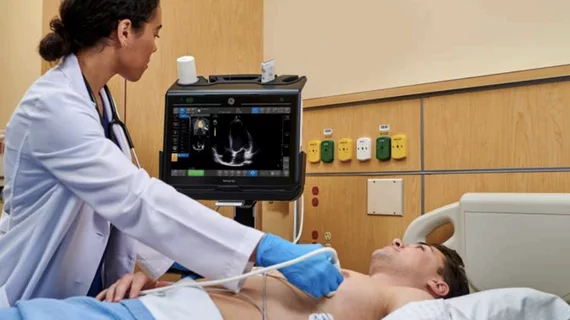
Use of point-of-care ultrasound (POCUS) in patients presenting to emergency departments with shortness of breath can significantly decrease hospital stays and the associated costs.
New data in JAMA indicate POCUS use in these patients can reduce hospital expenses by more than $1 million annually. Experts involved in the analysis suggest that, with just a small amount of ultrasound training, doctors’ reliance on stethoscopes in cases of dyspnea could drastically decline.
“The study clearly shows that ultrasound is the superior diagnostic technology, even for long-time stethoscope users who get a few hours of ultrasound training,” noted senior author Partho Sengupta, MD, chief of cardiology at Rutgers Robert Wood Johnson Medical School (RWJMS) in New Jersey.
Experts analyzed data compiled from two groups of patients—101 in a POCUS group and 107 in a control group—to compare length of stay (LOS) and hospitalization costs when POCUS is incorporated in assessments versus the standard of care. POCUS exams included a series of cardiac views and a six-zone lung sweep to check for signs of congestion and reduced systolic function.
Over a period of six months, POCUS yielded significant benefits among users. Ultrasound reduced patients’ LOS by 30%, down from 11.9 days to 8.3 days. This resulted in a reduction of 246 bed-days, which yielded direct cost savings of $751,537, or $3,055 per hospital bed–day. What’s more, the use of POCUS altered patients’ care plans in 35% of cases.
“The explanation here is simple. Ultrasound gives you more information, and more concrete information, about what’s going on,” Sengupta said. “When clinicians can see fluid in the lungs, a failing heart or a stiff inferior vena cava in minutes, they can target therapy sooner or rule out a cardiopulmonary cause and look elsewhere.”
The exams were designed to be short so that more providers would be encouraged to utilize the tool. Despite this, just 20% of hospitalists who completed the brief ultrasound training used it on their dyspnea patients. For this reason, the majority of exams were conducted by sonographers or cardiologists—a caveat that could hinder more widespread uptake.
“This is consistent with what we observe in day-to-day clinical practice,” Sengupta said. “Although the ultrasound probe fits in your pocket and attaches to the back of a smartphone, its use in clinical settings remains inconsistent. This study overcame those barriers by leveraging a multidisciplinary framework.”
More studies at different institutions are needed to determine how to best implement the technique, the authors acknowledged.
Learn more about the findings here.

In addition to her background in journalism, Hannah also has patient-facing experience in clinical settings, having spent more than 12 years working as a registered rad tech. She began covering the medical imaging industry for Innovate Healthcare in 2021.