
Internet searches reveal skyrocketing interest in POCUS implementation
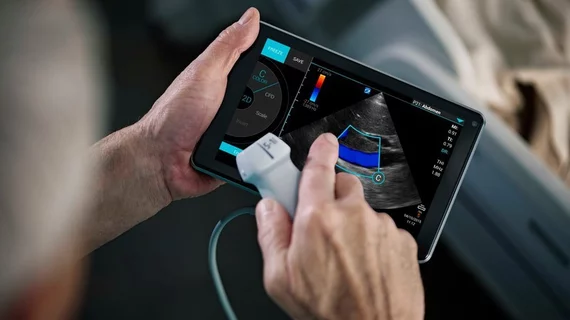
A recent study suggests that healthcare organizations have great interest in implementing handheld ultrasound devices into their workflows.
Published by Rivanna Medical—a medical imaging technology company—the results indicate that internet searches of “handheld ultrasound” have risen by nearly 500% since 2010. The results align with a rising interest in bedside point-of-care ultrasound (POCUS) to address growing patient demand.
“Our analysis looked at how handheld ultrasound devices are being used in clinical practice and how they compare to other types of ultrasound systems in the U.S. healthcare market,” the report explains. “The data, which shows the current market share for handheld, portable and traditional cart-based ultrasound devices, highlights which medical specialties are adopting handheld technology most rapidly, and details how many devices are in use across different specialties. This overview provides a snapshot of where handheld ultrasound stands today and how quickly it is gaining ground.”
POCUS devices currently make up just over 3% of the ultrasound market, but this is projected to grow at a compound annual growth rate (CAGR) of 24.7% through 2030. Though these handheld systems have utility in multiple medical settings, critical care and emergency providers appear to be the most interested in implementing them into clinical practice, as the devices can help to expedite care.
A recent study published in JAMA suggested that use of POCUS in emergency settings could save hospitals millions of dollars annually. The study, which focused specifically on patients presenting with shortness of breath, determined that POCUS reduced patients’ length of stay by 30%, down from 11.9 days to 8.3 days. This resulted in a reduction of 246 bed-days, which yielded direct cost savings of $751,537, or $3,055 per hospital bed–day. What’s more, POCUS altered patients’ care plans in 35% of cases.
The market value of handheld ultrasound devices is in line with these findings. The report indicates that projected value of these systems is expected to swell to $438 million by 2030.
For more on the report, click here.

In addition to her background in journalism, Hannah also has patient-facing experience in clinical settings, having spent more than 12 years working as a registered rad tech. She began covering the medical imaging industry for Innovate Healthcare in 2021.