
Contrast enhanced breast MRI superior to CEM, but accessibility remains an obstacle
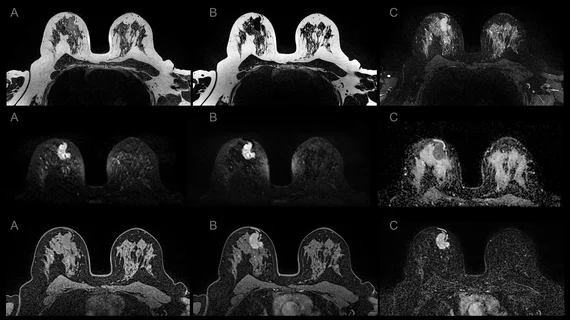
A new meta-analysis completed a side-by-side comparison of contrast enhanced breast MRI and contrast enhanced mammography, and revealed one modality to be superior for ruling out malignancy.
In a paper published June 7 in Radiology, experts shared that contrast enhanced breast MRI (CE-MRI) had higher sensitivity for breast cancer compared to contrast enhanced mammography (CEM). They arrived at this conclusion after analyzing 7 studies that investigated a total of 1,137 lesions.
In addition to CE-MRI's increased sensitivity for identifying breast cancers, the researchers also found that the modality had superior negative likelihood ratios with higher pre-test probabilities for safely ruling out malignancy.
Although the researchers observed CE-MRI of the breast to be more advantageous for ruling out cancer, it is not without its drawbacks. Pertaining to these, the paper’s corresponding author Pascal A. T. Baltzer, of the Department of Biomedical Imaging and Image-guided Therapy at the Medical University of Vienna and General Hospital, and colleagues commented:
“The application of CE-MRI poses several problems in the clinical workflow, including limited availability, relatively high costs (although not considered a limitation in cost-effectiveness research), and limited applicability in patients with metallic implants and claustrophobia or those in pain or poor general condition due to the longer scanning time.”
For both modalities, positive likelihood ratios were similar, but CEM did have a slight edge over CE-MRI in terms of specificity, at 74% compared to 69%, respectively.
The authors noted that, although CEM is less sensitive to cancer detection, it does have certain advantages, such as a higher likelihood of insurance coverage and the ability to be easily implemented into clinical workflows, making it more easily accessible than CE-MRI. This gave the authors pause in recommending one modality over the other.
“The limited amount of currently available data is inconsistent with the intense discussion on the topic. Thus, it is as of yet unclear how clinically relevant the diagnostic performance differences are between CEM and CE-MRI,” they wrote before recommending that larger studies in the future take cost-effectiveness into consideration.
The full study can be viewed in Radiology.
Related breast imaging content:
MRI-based radiomics boosts triple-negative breast cancer detection
DBT not the superior modality for assessing BI-RADS 4 breast lesions
Reactive lymphadenopathy slower to resolve after Moderna COVID vaccination
Imaging features predict survival in patients with luminal breast cancer
References:
Contrast-enhanced Mammography versus Contrast-enhanced Breast MRI: A Systematic Review and Meta-Analysis. Nina Pötsch, Giulia Vatteroni, Paola Clauser, Thomas H. Helbich, and Pascal A. T. Baltzer. Radiology.

In addition to her background in journalism, Hannah also has patient-facing experience in clinical settings, having spent more than 12 years working as a registered rad tech. She began covering the medical imaging industry for Innovate Healthcare in 2021.