
RadNet has allocated over $340M to acquisitions already in 2026. Leaders discuss why and what’s next
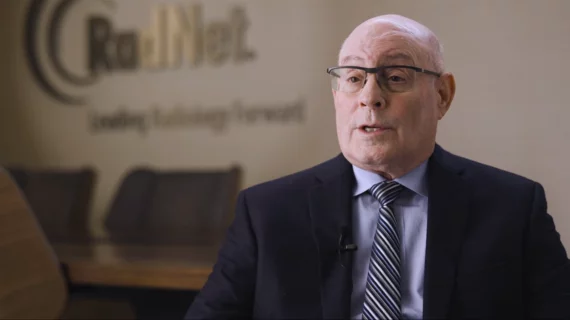
RadNet has announced the commitment of over $344 million in funds toward several high-profile acquisitions in 2026. Leaders discussed the rationale behind these deals and what comes next during the company’s quarterly earnings call on Monday.
Top of mind was RadNet’s recently announced deal to acquire radiology AI firm Gleamer for nearly $270 million. The Paris, France-based firm is fast-growing, offering cloud-based, software-as-a-service tools to over 700 customers across 44 countries.
RadNet said the acquisition will make it the largest provider of radiology AI tools in the world. Combined, the two will have an installed base of 2,700-plus customers with a portfolio containing 26 FDA-cleared devices spanning 75 indications.
Amid staffing challenges, CEO Howard Berger, MD, said it has become increasingly critical to “reengineer” high-volume workflows. This is particularly pertinent in modalities such as X-ray, ultrasound and mammography, where Gleamer holds expertise.
“For radiologists and providers, the key lies in advancing automated exam prioritization and draft reporting,” Berger said in a statement Monday. “The acquisition of Gleamer uniquely positions DeepHealth to expand its impact across routine imaging and high-impact acute diagnostic care and accelerate the delivery of automated diagnostics.”
More on the deal’s rationale
Berger and colleagues further discussed the rationale behind the blockbuster deal during RadNet’s quarterly earnings call on Monday.
Gleamer was first founded in France in 2017, aiming to bring clinically validated AI into radiology workflows, “helping doctors read faster and with greater confidence.” Co-founders include CEO Christian Allouche, an entrepreneur who studied economics and machine learning, and CMO Dr. Nor-Eddine Regnard, a French radiologist.
The company scored over $1.7 million in an initial seed-funding round in 2018, using it to accelerate research and development. Two years later, Gleamer launched BoneView in Europe, helping hospitals and radiology groups to detect fractures. Fast forward to today, and the company now has four FDA-cleared and six CE-marked AI solutions supporting 25 clinical indications. These include musculoskeletal, breast, lung and neurologic applications. Its solutions are designed to improve care quality while reducing radiologist workloads, with automated reporting capabilities already deployed in Europe, Kees Wesdorp, PhD, president and CEO of RadNet’s Digital Health Division, said during the investor call.
Gleamer achieved a compound annual growth rate exceeding 90% from 2022 to 2025 and is expected to log $30 million in annual recurring revenue this year. Wesdorp noted that the combination will allow RadNet to deliver an integrated, end-to-end platform that supports “every stage of the radiology workflow.” Their joined portfolio will unify clinical and agentic AI, operational intelligence and workflow automation spanning the entire patient journey.
Sham Sokka, PhD, RadNet’s chief operations and technology officer in its digital health division, further discussed the reasoning behind the acquisition. First, it expands DeepHealth’s portfolio across all core imaging modalities. Integrating Gleamer’s portfolio with RadNet’s clinical AI for breast, chest, neuro, prostate and thyroid disease creates a “comprehensive portfolio unrivaled by any other radiology AI company.” It will support screening, detection, interpretation and follow-up across many of the most prevalent cancer types, neurodegenerative and musculoskeletal conditions.
Adding Gleamer’s products, especially in “market leading” areas such as X-ray, will allow DeepHealth to provide solutions across all modalities. Sokka also said the acquisition will enhance RadNet’s commercial reach and scale, too. Gleamer is an AI leader in Europe and particularly France, with its assets “significantly strengthening” the company’s commercial engine. It will bolster RadNet’s global sales force with more than 40 team members, mostly in Europe, along with 80 additional employees in research and development. Scale will accelerate DeepHealth’s global trajectory and enhance its ability to deliver AI solutions worldwide.
Sokka also touted the chance to leverage Gleamer’s AI products to drive operational efficiency across RadNet’s highest-volume workflows. Deploying the acquired company’s solutions is expected to create measurable productivity gains, particularly in X-ray, which accounts for nearly 25% of its imaging volumes. Sokka said RadNet intends to implement an end to end, AI-enabled workflow, beginning with triaging critical findings, to accelerate interpretation of urgent cases.
CEO Berger also underlined the importance of “rounding out our portfolio in the routine imaging space.” Part of RadNet’s strategy, particularly with hospital partners, is to afford them the opportunity to have their entire provider network—physician groups, urgent care centers, emergency rooms—connected on the same imaging platform. He sees a “substantial market” for RadNet to tap into on the routine imaging side.
“The amount of opportunity that resides in what we like to call the ‘nontraditional imaging provider network’ is extraordinarily high,” Berger told investors. “Just to give some context to this, there are more than twice as many urgent care centers, and more rapidly growing, than there are outpatient imaging centers across the U.S. So, these kinds of transformative tools will allow us to enter onto another platform where we are not necessarily constrained with traditional reimbursement for claims but rather to be part of the delivery system of healthcare that we can help the providers benefit from by, again, earlier detection and greater opportunity to advance the patient journey on as timely a basis as possible.”
Sokka said the new workflow approach is aimed at optimizing internal resource utilization, resulting in improved operations and cost efficiencies. He anticipates RadNet will begin seeing benefits as soon as this year. Gleamer has developed automated-reporting capabilities where AI is able to create the clinical report on behalf of a radiologist “without human intervention.” This feature is already in early deployment with customers in Europe. When combined with the DeepHealth's AI and informatics portfolio, RadNet will be able to bring clinical, generative and agentic AI together into one integrated offering.
Wesdorp also touted the potential financial benefits. RadNet sees opportunity to cross- and upsell services to its new expanded customer base. Leaders said an estimated 80% to 90% of customers, between the two companies, present an opportunity for selling additional solutions.
The sizable transaction cost—which factors in post-closing milestones—reflects Gleamer’s high multiyear recurring revenue growth, solid cloud-native gross margins, and strong customer retention. The acquisition is expected to create “meaningful” growth and cost synergies for RadNet at an estimated $7 million while accelerating Gleamer’s path to positive earnings by mid-2027. That’s much faster than it likely would have performed on its own, Wesdorp said.
“In summary, the acquisition of Gleamer is a transformative milestone for us,” he told investors.
Other acquisitions
RadNet leaders also on Monday discussed the potential for further acquisitions both on the AI and imaging center sides of its business.
Besides Gleamer, RadNet allocated $65 million toward the purchase of 13 outpatient imaging centers in Florida from LucidHealth, announced in January. It’s spending another $9 million to acquire six additional imaging centers around Indianapolis from Northwest Radiology, announced in February. Altogether, the two acquisitions will add nearly $120 million in new revenue to RadNet’s bottom line, leaders estimated.
Berger said the company continues to see opportunities for smaller “tuck-in” acquisitions. However, those are “being dwarfed” by other potentially larger hospital systems that are interested in partnering with RadNet.
“The landscape is changing out there very rapidly, and I think RadNet’s capabilities are being better appreciated as perhaps a unique opportunity to give them benefits across the entire spectrum of radiology,” Berger said.
RadNet is now eyeing avenues to build around its recent acquisitions in Indiana and southwest Florida. The company is in active discussion about expansion in the two states, which could potentially come through further acquisitions or constructing new centers. RadNet is expected to open between 11 and 13 “de novo” imaging sites by the end of this year, leaders estimated.
You can read more about the company’s quarterly earnings results and find a recording of the call here.

Marty Stempniak has covered healthcare since 2012, with his byline appearing in the American Hospital Association's member magazine, Modern Healthcare and McKnight's. Prior to that, he wrote about village government and local business for his hometown newspaper in Oak Park, Illinois. He won a Peter Lisagor and Gold EXCEL awards in 2017 for his coverage of the opioid epidemic.