
Study: PE rule-out criteria could eliminate CT for some patients
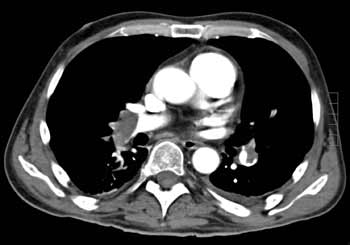 |
| CTA with bilateral pulmonary emboli. |
Typically, patients with PE present to the emergency department with nonspecific clinical symptoms. “Emergency physicians have been increasing their use of diagnostic testing in an attempt to avoid missing this potentially life-threatening diagnosis, increasing both costs and use of medical resources,” wrote Subhash Chandra, MD, of Greater Baltimore Medical Center in Towson, Md., and colleagues.
The PERC clinical decision rule was developed to provide pretest probability of PE and determine which patients could defer D-dimer testing, and thus avoid subsequent imaging.
The researchers conducted a systemic review and meta-analysis to summarize the diagnostic accuracy and reliability of PERC.
Chandra and colleagues reviewed 11 studies of PERC which included 13,885 patients and found 97 percent sensitivity for pulmonary embolism. Specificity was lower at 23 percent, but the researchers said it was acceptable. PERC missed fewer than 0.5 percent of pulmonary embolisms.
"Our study has the potential to reduce both costs and the use of medical resources, particularly CT scans, which subject patients to radiation," Chandra said in a statement. “The PERC rule can be used with confidence in settings of low pretest probability. Our study found consistent high sensitivity and negative predictive value of PERC with very few pulmonary embolisms missed.”
The researchers determined the findings provided level 2 evidence, which demonstrates accuracy in either a single large and broad prospective study or validation in small settings that differ from one another.
"Application of a well-validated clinical decision rule like PERC should decrease the excessive testing that has resulted from physician fears of litigation over missing pulmonary embolisms," concluded Chandra.